
Unlike extrusion, which relies on high pressure, or disc granulation, which utilizes the rolling action across a disc surface, a rotary drum granulator functions by allowing material to tumble for an extended period within a rotating cylindrical drum. Particle strength is not "pressed" into existence; rather, it is "cultivated" through repeated collisions, friction, and adhesion.
The drum is typically filled to 20%–30% of its capacity, and it rotates at a relatively low speed, causing the material to cascade downward like a waterfall. With each rotation, a layer of fine powder adheres to the surface, bound together by moisture, gradually densifying the particle layer by layer. A longer residence time results in more layers, producing rounder, stronger granules. Consequently, the critical parameter is not pressure, but time—determined by the drum’s length, inclination angle, and rotational speed. If the rotation is too fast, centrifugal force pins the material against the drum wall; if it is too slow, the material accumulates without advancing, leading to a drop in the granulation rate.
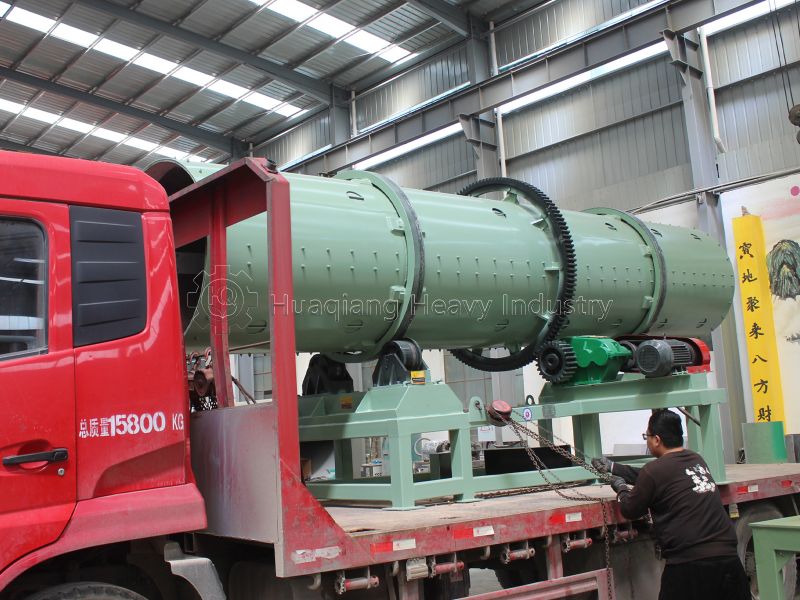
Water must be atomized and sprayed onto the "curtain" of falling material, rather than poured directly onto the material bed. Direct pouring creates localized over-wetting—forming large, unwanted clumps while leaving the rest of the material as dry powder—whereas atomized water distributes evenly as the material tumbles, ensuring a thin, uniform coating.
This logic of "cultivating granules through rolling" makes the rotary drum ideal for continuous, high-capacity production, while also dictating its inherently "slow" nature: granules require time to grow, and they cannot be "rushed" by simply increasing the rotational speed. Many production lines struggle during commissioning precisely because the rotary drum is mistakenly treated as a compression device; the result is loose, fragile granules and a sharp spike in the volume of material that must be recycled back into the process.
A rotary drum granulator is better understood as a "cultivation line" for granules rather than a compression line. The process should begin by establishing the required residence time, followed by optimizing the rotational speed and inclination angle, and finally calibrating the water-spraying position. When it comes to building particle strength, there is no shortcut.