

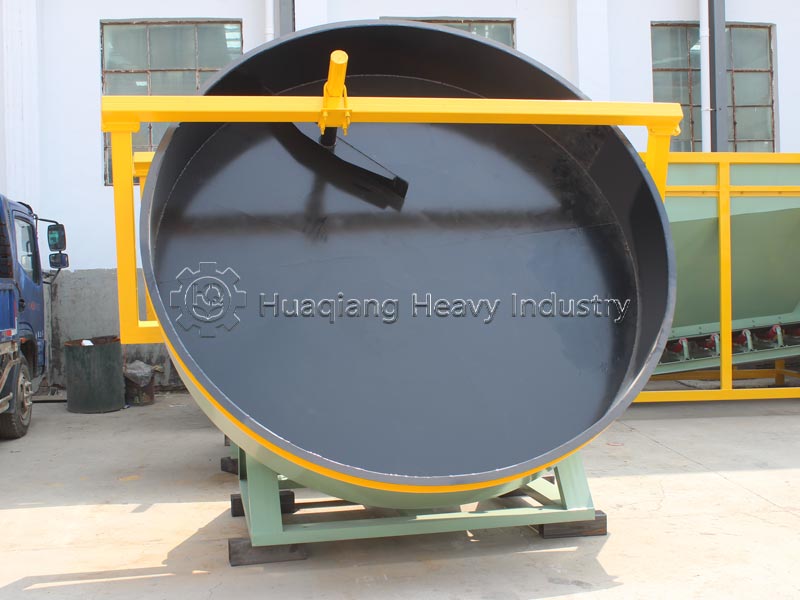
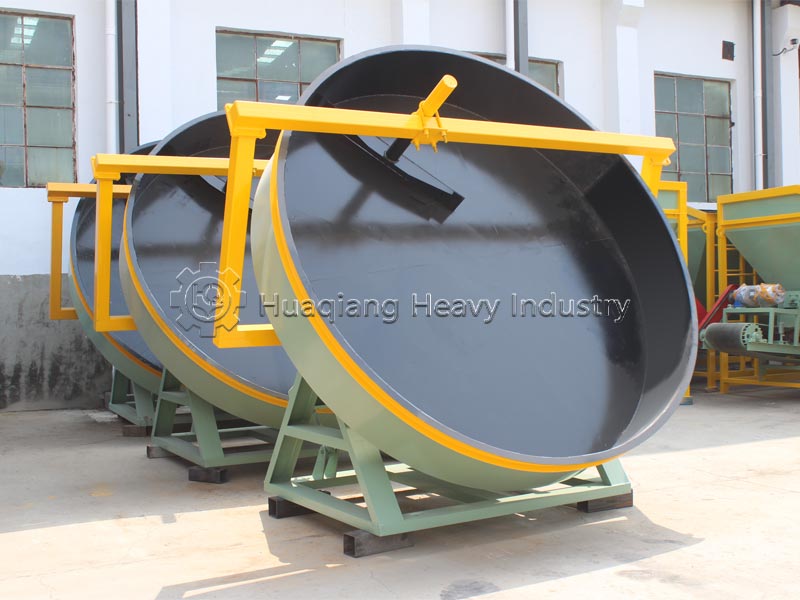
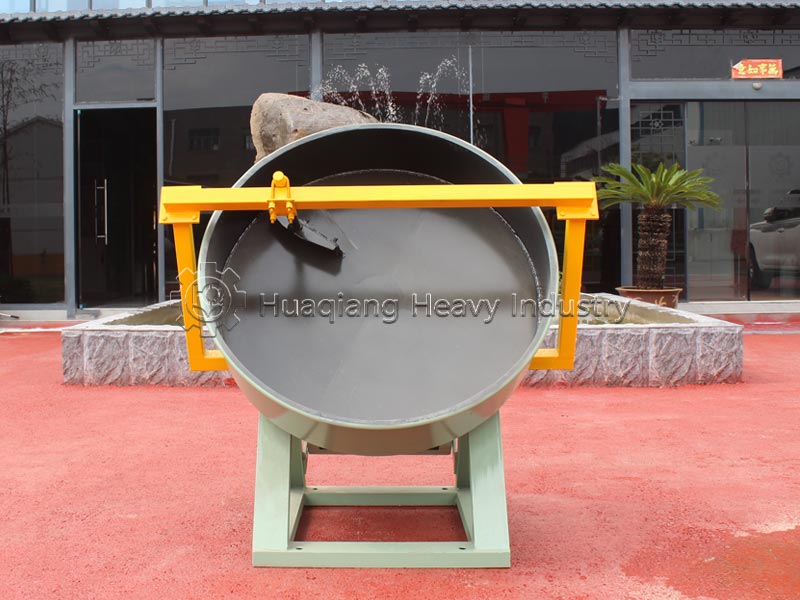
The disc granulator is a wet granulation device that utilizes a rotating disc to roll powdered materials into spheres under humidified conditions. Through the combination of the disc's inclined rotation and a spraying system, materials roll and bond on the disc surface, accumulating in layers to form round, uniform granules. Key advantages include excellent sphericity, controllable particle size, and intuitive operation; it is a mature and widely used workhorse in wet granulation processes. The machine features a simple structure, stable operation, and moderate investment costs, making it particularly suitable for manufacturers with high standards for granule appearance.
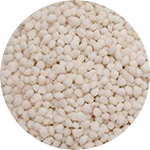
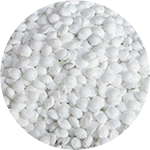
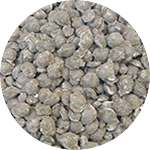
Working Principle of Disc Granulator
Mixed powdered material is continuously fed via a conveyor into the inclined, rotating disc, while a spray pipe applies an appropriate amount of water or binder solution to the material inside. As the disc rotates at a constant speed, the moistened powder tumbles, collides, and bonds, gradually forming tiny granule nuclei. These nuclei continue to pick up fresh powder as they rotate, growing layer by layer—much like a rolling snowball—until the desired particle size is achieved. Driven by centrifugal force and the disc's inclination, the formed granules spill over the edge and are discharged via a chute. The size and strength of the finished granules can be flexibly controlled by adjusting the spray volume, feed rate, disc rotation speed, and inclination angle.
Structural Components of
Disc Assembly: A disc body fabricated from welded steel plate; the working surface is smooth and flat, featuring a rim to prevent material spillage. Disc diameters range from 1.2 to 6 meters, selected based on production capacity requirements.
Frame and Base: A welded structure made of structural steel and plate, designed to support the disc and withstand rotational loads. The base includes an inclination adjustment mechanism—using a lead screw or hydraulic system—to set the angle between the disc and the horizontal plane, typically adjustable within the 40°–60° range.
Drive System: The main motor drives a pinion gear via a pulley or speed reducer; this pinion meshes with a large gear ring at the bottom of the disc, driving the disc to rotate at a constant speed. Main Shaft and Bearing Housing: The main shaft is mounted vertically at the center of the disc's underside, bearing both axial and radial loads. The bearing housing utilizes double-row roller bearings, ensuring excellent lubrication and a long service life.
Spraying System: Comprising spray pipes, nozzles, and control valves, this system is installed at an optimal position above the disc. The nozzles allow for adjustable flow rates and spray angles, ensuring uniform moisture distribution across the material's rolling zone.
Feeding and Discharge Systems: The feed inlet is located above the disc, typically connected to a conveyor belt or screw conveyor that supplies pre-mixed materials. The discharge outlet is situated at the lower side of the disc, collecting the finished granules as they spill over and transferring them to the next processing stage.
Performance Characteristics of
Uniform, Rounded Granules: Materials roll into spheres within the disc, resulting in spherical or near-spherical granules with smooth surfaces; the product boasts high visual appeal and market acceptance.
High Granulation Rate: With proper adjustment of moisture and rotation speed, the granulation rate can reach 70%–85%. Un-granulated fines that spill over with the product can be screened and returned to the disc for further processing, ensuring high material utilization.
Intuitive and Simple Operation: The granulation process is clearly visible on the disc surface; operators can assess granule quality based on experience and make timely adjustments to feed and water rates, making the system easy to master.
Flexible Particle Size Control: Finished particle sizes can be flexibly controlled within a specific range by adjusting the disc inclination angle, rotation speed, and water spray volume, meeting diverse product specifications.
Economical Investment: Compared to dry granulation equipment (such as double-roll presses), the disc granulator features a simple structure and lower manufacturing costs. It offers a more economical investment for equivalent production capacity, making it ideal for small-to-medium-scale operations.
Application Fields for
Agricultural Fertilizers: High, medium, and low-concentration compound fertilizers; organic-inorganic compound fertilizers; bio-organic fertilizers; humic acid fertilizers.
Construction Materials: Cement raw meal pelletizing; limestone powder pelletizing; ceramsite sand granulation.
Chemical Industry: Catalyst carrier pelletizing; spheroidization of powdered materials.
Metallurgical Industry: Concentrate powder pelletizing; iron ore pellet production.
Environmental protection sector: Solidification and granulation treatment of wastes such as fly ash and sludge.
| Model | Capacity(t/h) | Diameter(mm) | Side Height(mm) | Rotation Speed(r/min) | Motor Power(Kw) |
| ZL-500 | 0.05-0.15 | 500 | 150 | 25 | 1.5 |
| ZL-800 | 0.1-0.3 | 800 | 200 | 25 | 1.5 |
| ZL-1000 | 0.1-0.35 | 1000 | 250 | 25 | 2.2 |
| ZL-1200 | 0.1-0.35 | 1200 | 250 | 25 | 3 |
| ZL-1500 | 0.3-1 | 1500 | 300 | 18 | 3 |
| ZL-1800 | 0.5-1.2 | 1800 | 350 | 18 | 4 |
| ZL-2000 | 0.5-1.5 | 2000 | 400 | 18 | 5.5 |
| ZL-2500 | 1-2.5 | 2500 | 400 | 13.6 | 7.5 |
| ZL-2800 | 2-3 | 2800 | 500 | 13.6 | 11 |
| ZL-3000 | 2-3 | 3000 | 500 | 11 | 11 |
| ZL-3200 | 3-5 | 3200 | 500 | 10 | 11 |
| ZL-3600 | 3.5-6 | 3600 | 500 | 10 | 18.5 |