
The rotary drum granulator is one of the most widely used wet granulation devices in large-scale compound fertilizer production. It utilizes steam heating and the heat generated by the material's own chemical reactions to cause powdered fertilizer to roll and agglomerate into granules within a rotating drum. Characterized by high single-unit capacity and stable operation, it serves as the primary granulator model for large-scale fertilizer production lines. The rotary drum granulator offers distinct advantages in terms of production capacity, automation, and granule quality, making it particularly suitable for high-concentration compound fertilizer production lines with daily outputs ranging from hundreds to over a thousand tons.
Working Principle of
The rotary drum granulator relies on the rotation of the drum to induce internal material rolling, achieving granulation through steam heating and liquid-phase bonding. Powdered compound fertilizer is fed via a belt conveyor into the inlet end of the rotating drum, which is installed at a specific inclination. Friction against the inner drum wall lifts the material to a certain height before gravity causes it to roll down, creating a continuous cascading curtain of material. Simultaneously, low-pressure steam is introduced into the drum, heating the material to 50–70°C; under the influence of heat and moisture, certain fertilizer components undergo chemical reactions and dissolve, generating a specific amount of liquid phase. This liquid phase distributes evenly across the surface of the powder particles, acting as a binder that allows the particles to gradually agglomerate into spheres through rolling and collision. As the drum rotates, the granules gradually move toward the discharge end and are ultimately expelled through the outlet.
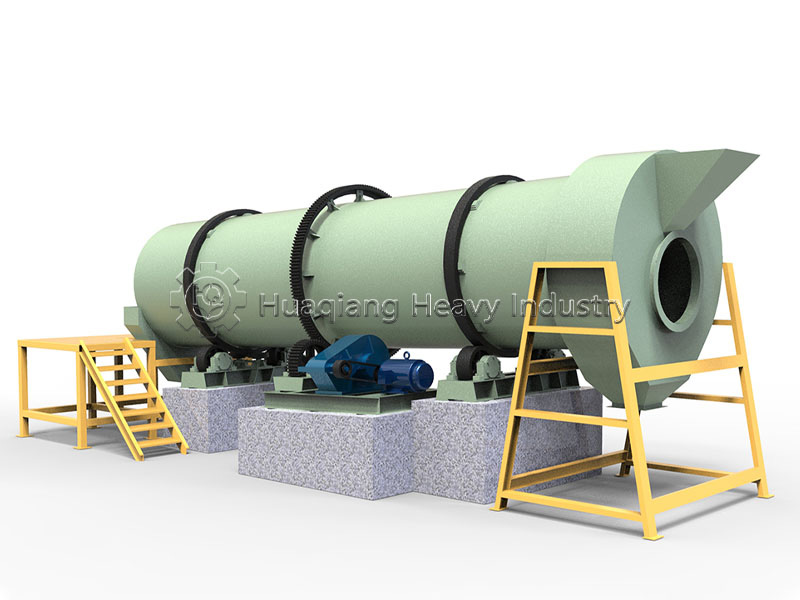
Structural Components of Rotary Drum Granulator
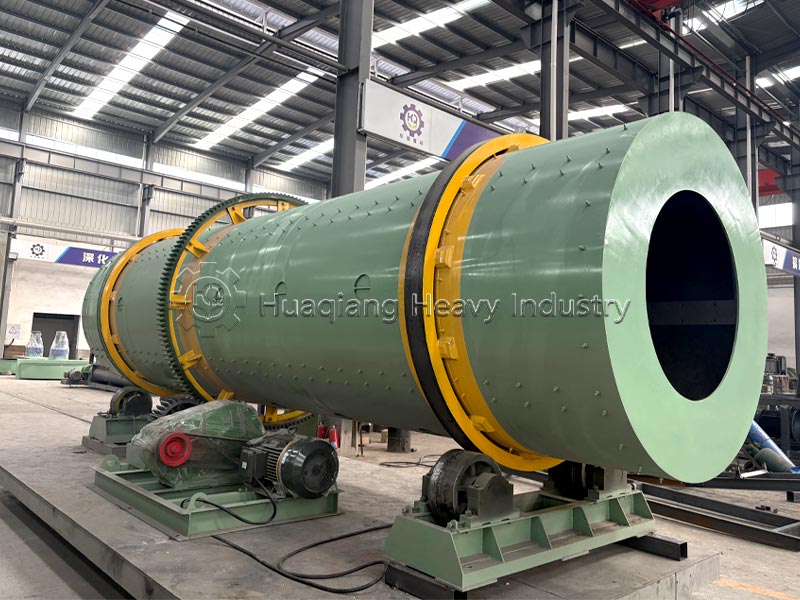
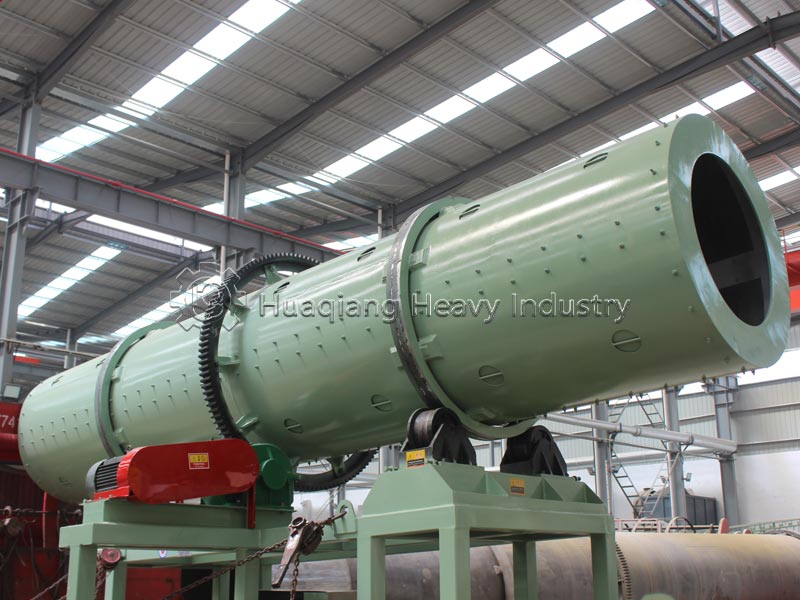
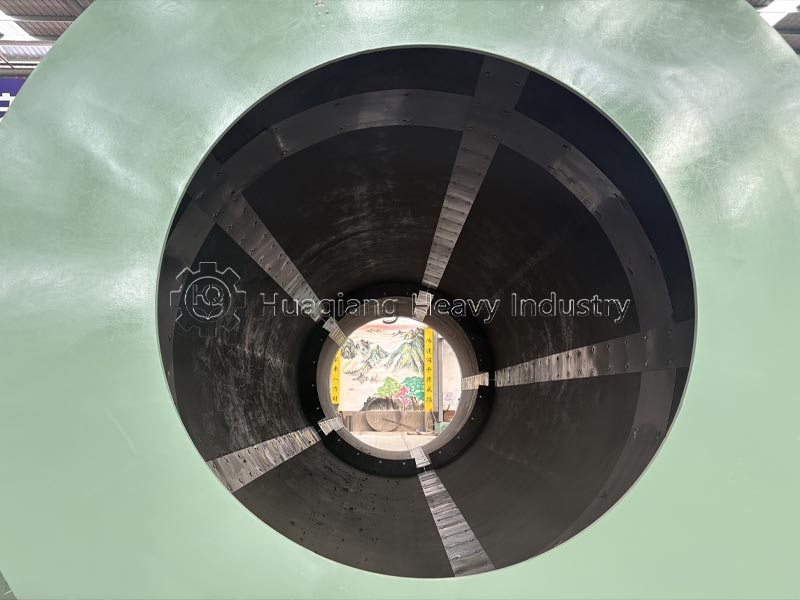
Drum Assembly: A cylindrical rotating drum fabricated from rolled and welded steel plate, featuring inlet and outlet hoppers at either end. The inner wall is lined with anti-stick, corrosion-resistant rubber to prevent wet material from adhering to the surface. The drum's inclination angle is adjustable between 2° and 5°, influencing material residence time and granulation performance.
Drive System: The main motor connects to a gearbox via a fluid coupling or variable frequency drive (VFD), driving a pinion gear that meshes with a large girth gear to rotate the drum at a constant speed. The girth gear is a precision-machined cast steel component bolted to the drum flange, ensuring smooth operation and high load-bearing capacity.
Support and Thrust Roller Assembly: The drum is supported by four sets of support rollers, which bear the entire weight of the drum and ensure smooth rotation. Thrust rollers are installed on the underside of the drum to prevent axial shifting and maintain a stable operating position.
Feed and discharge units: The front feed box features a feed chute and a steam inlet; steam is injected uniformly into the drum via nozzles. The rear discharge box connects to a discharge chute, directing the finished granules to subsequent drying or screening stages.
Steam system: Low-pressure boiler steam or waste-heat steam is piped into the drum. Adjustable steam pressure and flow rates serve as key controls for granulation temperature and liquid-phase content.
Scraping mechanism: Adjustable scrapers or blades mounted on the inner drum wall promptly remove adhered material, keeping the wall clean and ensuring smooth material tumbling.
Electrical control system: The control cabinet integrates functions such as variable-frequency speed control for the main motor, steam flow regulation, and feed/discharge interlocking. It communicates with the plant-wide central control system to enable automated operation.
Performance Characteristics of
High production capacity: A single unit can achieve hourly outputs of 10–50 tons or more. It is a critical piece of equipment for high-yield, large-scale compound fertilizer lines, meeting industrial demands for daily outputs of hundreds of tons.
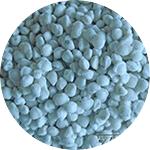
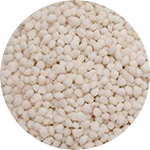
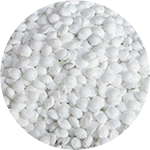
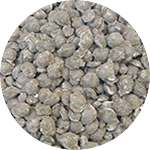
Excellent granule quality: Repeated tumbling within the drum produces spherical or near-spherical granules with smooth, dense surfaces. The granules possess high strength and resistance to breakage, resulting in low dusting rates during storage and transport, as well as an attractive commercial appearance.
Strong process adaptability: Suitable for granulating a wide range of fertilizers—including high-, medium-, and low-concentration compound fertilizers, ammonium phosphate-based fertilizers, and organic-inorganic compound fertilizers—with broad formulation compatibility.
Continuous, stable operation: The drum rotates at a constant speed with continuous feeding and discharging, making it ideal for 24-hour uninterrupted production. The equipment runs smoothly and, with proper maintenance, ensures long-term, trouble-free operation.
Convenient operation and adjustment: Steam consumption, drum rotation speed, and feed rate can be adjusted independently. Clear operating parameters ensure process reproducibility and facilitate standardized management.
Application Feilds for Rotary Drum Granulator
Agricultural Fertilizers: High-concentration compound fertilizers (e.g., 15-15-15, 17-17-17, etc.), MAP/DAP-based compound fertilizers, urea-based compound fertilizers, and organic-inorganic compound fertilizers.
Chemical Industry: Granulation of straight fertilizers such as ammonium chloride and ammonium sulfate; agglomeration granulation of certain chemical powders.
Production of Sulfur-based and Chlorine-based Compound Fertilizers: The equipment imposes no specific requirements regarding the acid radical system, making it adaptable to various formulations, including sulfur-based and chlorine-based types.
Large and Medium-sized Fertilizer Enterprises: Drum granulation serves as the primary process solution for large-scale compound fertilizer production lines with daily capacities ranging from 200 to 1,000 tons.
| Model | Diameter(mm) | Length(mm) | Inclination(°) | Rotation Speed(r/min) | Capacity(t/h) | Motor Power(Kw) |
| ZG1.2*4.0 | 1200 | 4000 | 2.5 | 17 | 1-3 | 5.5 |
| ZG1.5*6.0 | 1500 | 6000 | 2.5 | 11.5 | 3-5 | 7.5 |
| ZG1.8*7.0 | 1800 | 7000 | 2.5 | 11.5 | 6-10 | 18.5 |
| ZG2.0*8.0 | 2000 | 8000 | 2.5 | 11 | 10-15 | 22 |
| ZG2.2*12 | 2200 | 12000 | 2.5 | 10.5 | 15-20 | 37 |