
The structure of a disc granulator is remarkably simple: an inclined, rotating disc paired with a water-spraying system. Devoid of complex sensors or closed-loop control, it relies heavily on the operator’s "intuition"—a nuanced, tactile sense of the process.
The formation of granules is essentially a dynamic equilibrium: as material travels upward on the rotating disc, it eventually rolls back down, accumulating layer upon layer to grow in size. The disc’s inclination angle, rotational speed, and water-spray rate must be perfectly synchronized in real time. If the angle is too shallow, material rolls down too quickly, preventing the nuclei from growing; if it is too steep, the material simply spins in place without rolling, leading to the formation of large, unwanted clumps. If the rotational speed is too high, fine particles are flung toward the edge of the disc; if it is too low, the material stagnates. Water application is equally delicate: a bit too much, and the material sticks to the disc; a bit too little, and it creates excessive dust.
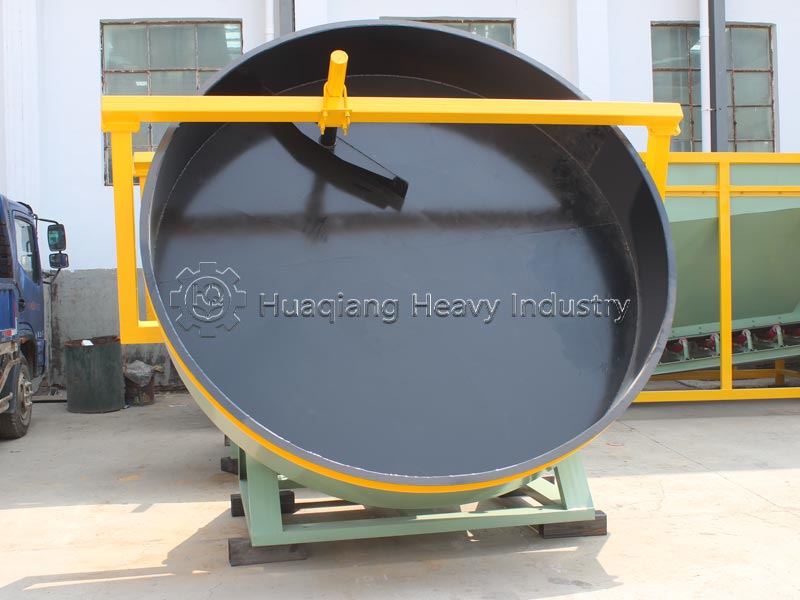
The challenge lies in the fact that the optimal configuration shifts constantly based on the material’s moisture content, viscosity, and fineness—and even ambient temperature and humidity. There is no fixed formula, and sensors struggle to capture the complex rolling dynamics occurring on the disc. Consequently, the operator’s eyes and hands become the most reliable "sensors": they judge the inclination angle by observing the flow of material, gauge the water level by listening to the sound, and assess the progress of granulation by feeling the output.
This "intuition" is not some mystical quality, but rather a form of pattern recognition honed through long-term experience. A skilled operator can make adjustments within the first few minutes of a change in material properties, whereas a system with fixed parameters often reacts too slowly. This is precisely why the organic fertilizer disc granulator remains difficult to replace in small-to-medium-scale operations that frequently switch between different formulations—whenever the recipe changes, the parameters must be "re-calibrated" by feel, a task at which humans excel far more than programmed systems.
While this reliance on human intuition makes standardization difficult and leaves batch consistency vulnerable to individual operator variability, it also offers a distinct advantage when dealing with organic materials—which are, by their very nature, inherently "non-standard."