
The advantage of a rotary drum granulation production line lies not in the sophistication of any single piece of equipment, but in the overall stability of the entire line when operating continuously at high capacity. This manifests in four key areas:
First, it offers robust continuous operation. The rotary drum granulator’s cylinder rotates steadily, allowing for a continuous flow of material—unlike disc granulation, which requires batch-based processing, or extrusion granulation, which is prone to issues like die-hole clogging. Material enters at one end and exits at the other, with residence time precisely controlled via the cylinder’s inclination angle and rotational speed, enabling 24-hour uninterrupted operation. For plants with an annual output of tens of thousands of tons, continuous production helps dilute fixed costs per unit of capacity.
Second, it is highly tolerant of fluctuations in raw materials. The large volume of material inside the drum ensures thorough mixing; if there are minor variations in moisture content or viscosity, the ample buffer space within the cylinder prevents the granulation process from becoming unstable. Furthermore, the system’s self-regulating capability is enhanced by a "recycle" (return-material) system, which feeds undersized or substandard particles back into the drum for further granulation. In contrast, disc granulation is far more sensitive to material variations, often making it difficult to adjust operating parameters quickly enough to compensate for such changes.
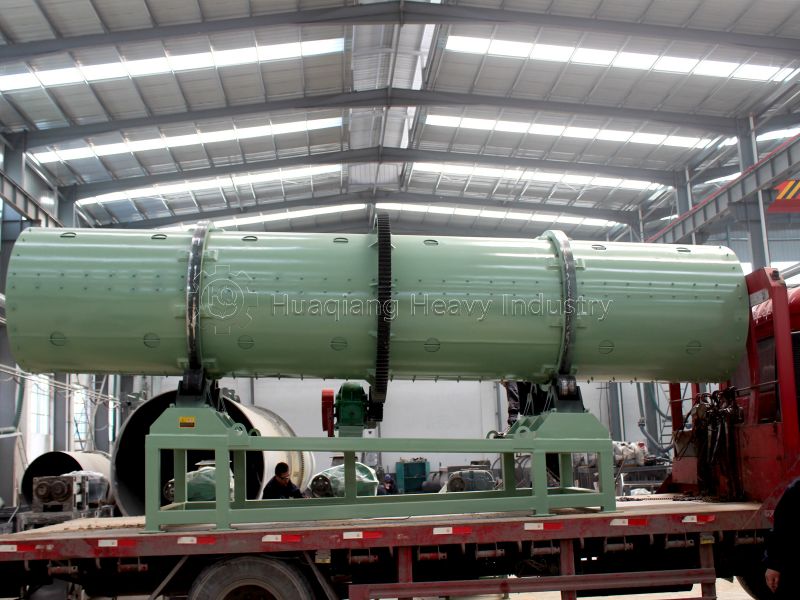
Third, it achieves a balance between granule strength and uniformity. As particles tumble repeatedly, they become increasingly dense, resulting in inherently stronger granules compared to the looser, agglomerated structures produced by disc granulation. The material is distributed evenly as a "curtain" within the drum, and particle size can be consistently maintained within a target range through screening and recycling. This ensures high product uniformity—an essential quality for storage, transport, and mechanical application, where granule strength is critical.
Fourth, it ensures seamless process integration. A rotary drum granulation line aligns naturally with downstream stages such as drying, cooling, screening, and coating. Wet granules move directly from the granulator into the dryer, creating a coherent workflow with minimal material handling. This reduces dust emissions and product loss, while also facilitating a higher degree of overall system automation.
Admittedly, a rotary drum granulation production line entails a higher initial investment and a larger physical footprint than a disc granulation production line, which may not make it the most cost-effective choice for small- or medium-scale projects. However, for large-scale, continuous operations requiring consistent product specifications, it offers systemic advantages—it is highly stable, robust, and easily scalable—which is precisely why large-scale projects favor this approach.