
A key, often overlooked, trade-off in selecting a bulk blending fertilizer machine is the inverse relationship between mixing uniformity and granule integrity. More vigorous mixing improves uniformity but leads to greater granule breakage; conversely, gentler mixing preserves the granules but may compromise uniformity.
When evaluating uniformity, do not rely solely on nominal specifications. The Coefficient of Variation (CV) values provided in product literature are typically measured under standardized conditions; in actual production, variations in raw material particle size and specific gravity can significantly degrade uniformity. You should request a test run using your own specific formulations, with nutrient deviation checked at multiple points within the mixture—a CV value of 5% or less is generally considered acceptable.
Next, consider residual material, which directly impacts cross-contamination between batches. Bulk blending operations often involve frequent formula changes; if tens of kilograms of material from a previous batch remain in the vessel, the subsequent batch will be diluted. Horizontal ribbon mixers generally leave less residue, but it is essential to verify that the discharge port design and the curvature of the vessel bottom facilitate complete emptying. Drum-type mixers offer a simple design and low residue, though they typically require longer mixing times.
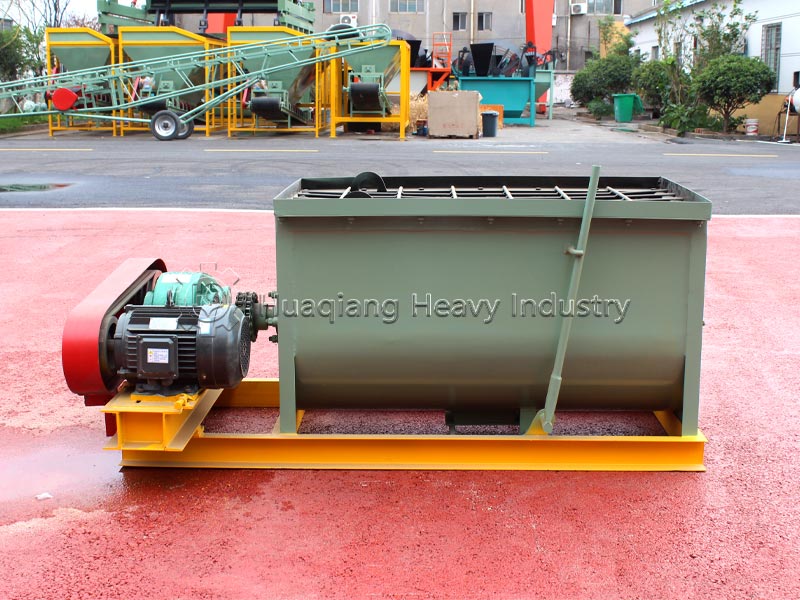
Granule integrity depends on rotational speed and the design of the internal lifting flights (paddles). A low rotational speed (20–40 rpm) is a baseline requirement, but the shape and angle of the lifting flights determine whether the material "tumbles" or is "thrown." A "throwing" action increases efficiency but also leads to higher breakage rates, while a "tumbling" action is gentler—though it may pose a greater challenge for achieving uniformity when materials have significant differences in specific gravity.
Finally, do not overlook ease of cleaning and integration with the batching system. In operations involving multiple formulations, the ability to quickly clear the vessel is critical for efficient product switching. Additionally, the heights of the inlet and discharge ports must be carefully calculated to ensure proper alignment with batching scales and packaging machinery.
A bulk blending fertilizer machine is not necessarily better simply because it is more expensive; the best choice is the one that aligns most closely with your specific product requirements. Start by defining the particle size specifications of your bulk-blended (BB) fertilizers and the frequency with which you change formulations; then, work backward to determine the necessary equipment parameters to ensure you make the right selection.