
In NPK fertilizer production lines, the granules produced by the granulators are of varying sizes—fine powder, small granules, and large lumps are often mixed together. Without screening, the powder will lead to uneven fertilization, and the large lumps will clog the fertilizer applicator. The screening process plays a crucial role in this process.
The screening process performs two core tasks: first, separating qualified products from the mixture; and second, diverting unqualified materials. Fine powder and large granules are returned to the system for reuse, while only intermediate products with uniform particle size can continue.
The production line typically has two screening devices operating in tandem. The granulated and dried material first enters the pre-screening stage to remove large clumps and prevent them from abrading subsequent equipment. The cooled material then enters the fine screen for final grading.
The most widely used is the fertilizer drum screener machine. It is an inclined polygonal drum with screens of different aperture sizes distributed on its walls. Material enters from the inner cylinder; fine powder falls through small holes, qualified granules flow out from the middle section, and large pieces are discharged from the tail. The drum rotates slowly, ensuring that every particle has a chance to contact the screen surface.
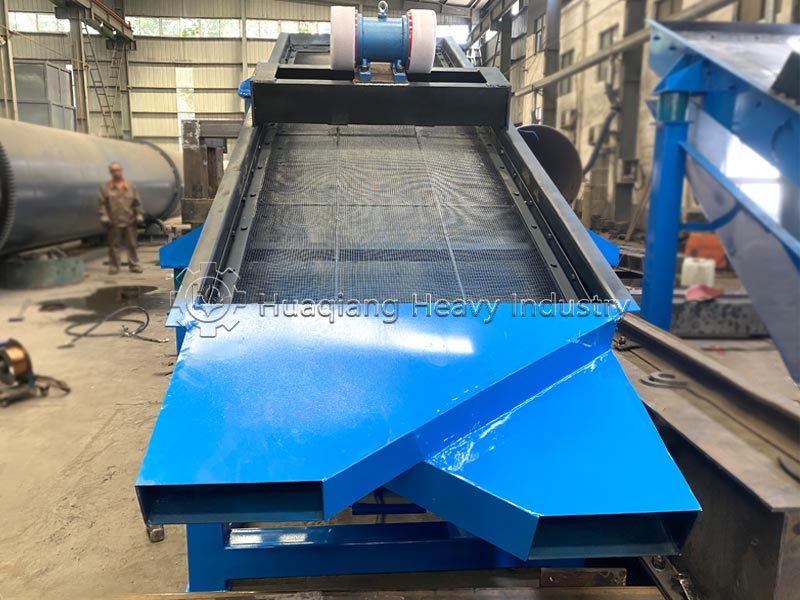
Fertilizer vibration screener machines are characterized by high-frequency vibration. The material jumps forward on the screen surface, resulting in rapid stratification and high screening efficiency. For sticky materials, the vibrating screen is also equipped with an anti-clogging device to prevent fine powder from clogging the screen.
The ingenuity of the screening process lies in its closed-loop circulation design. Fine powder returns to the granulator, and large particles, after being crushed, also return to the starting point; only qualified particles enter the packaging. This design ensures product quality while maximizing material utilization.