
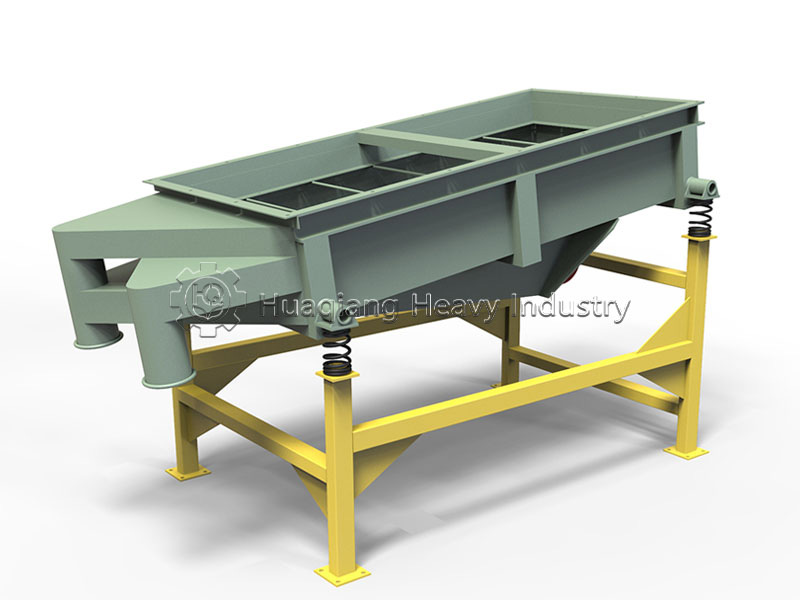
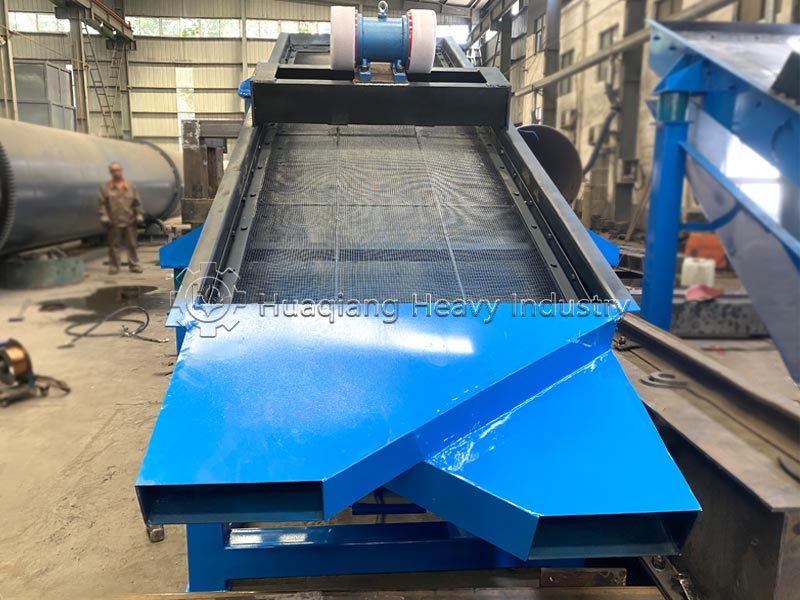
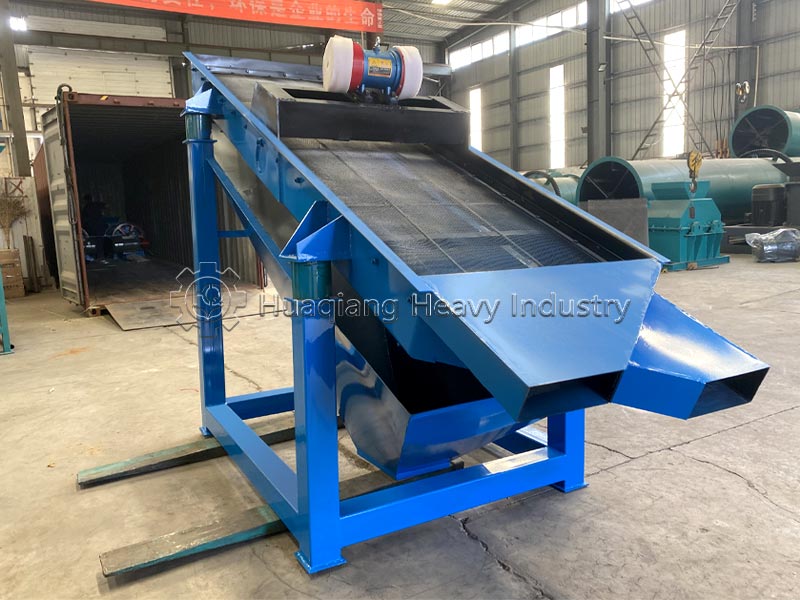
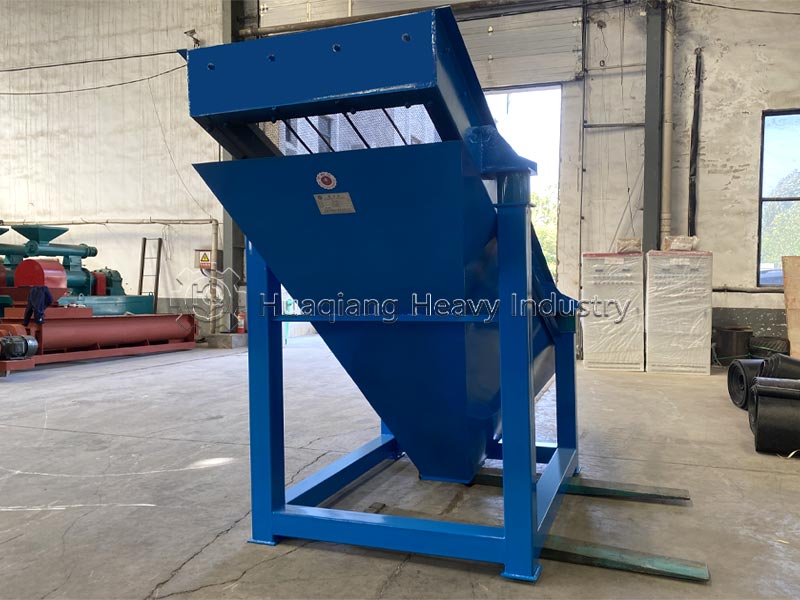
A vibration screener machine is a screening device used in the fertilizer industry for fine grading and de-dusting of granular materials. It utilizes a vibrating motor or exciter to generate high-frequency vibrations, causing the material to jump, be thrown, and move forward on the screen surface. Fine particles pass through the screen holes, while coarse particles are discharged along the screen surface, achieving precise material separation. In organic fertilizer and compound fertilizer production lines, vibration screener machines are often used in conjunction with drum screener machines for final de-dusting and grading of granulated products, or for removing impurities from powder before granulation. The equipment offers high screening accuracy and moderate processing capacity, making it an important piece of equipment for ensuring the uniform appearance and particle size of the finished granules.

Working Principle
The vibration screener machine generates directional vibrations through a vibrating motor or exciter mounted on the screen body, causing the screen surface to jump at high frequency with small amplitudes. After entering the screen surface, the material is thrown up and moves forward under the action of vibration, forming a continuous material layer. During the jumping process, the particles repeatedly contact the screen surface. Material smaller than the screen hole size passes through the screen hole and falls to the lower layer, while material larger than the screen hole moves forward along the screen surface and is discharged from the outlet end. Multi-layered screens can simultaneously perform multi-level grading. Amplitude and vibration frequency are adjustable to adapt to different materials and grading accuracy requirements.
Equipment Composition
Screen Body: A screen box welded from steel plates, supporting the screen mesh and vibrating components, and bearing the vibration load.
Screen Mesh: Made of stainless steel woven mesh or polyurethane screen plate; the aperture is selected according to grading requirements and can be quickly replaced.
Vibration Source: A vibrating motor or eccentric block vibrator generates directional vibration force; this is the core component of the equipment.
Damping Springs: Support the screen body and isolate vibration, reducing vibration transmission to the foundation and frame.
Inlet/Outlet: The inlet is equipped with a buffer and equalization device; the outlet has multiple channels to collect materials at each grade.
Frame: Welded steel base, supporting the screen body and connected by shock-absorbing springs.
Performance characteristics
High screening accuracy: High-frequency, small-amplitude vibration ensures thorough separation of fine particles, resulting in higher screening efficiency than drum screener machines.
Moderate processing capacity: Suitable for small to medium throughput or fine grading applications, with a large throughput per unit screen surface.
High screen surface utilization: Material jumps and advances on the screen surface, reducing screen clogging.
Diverse grading: Can be configured with multiple screens to obtain products of various particle sizes in a single screening.
Convenient adjustment: Amplitude and frequency are adjustable to adapt to different material characteristics and screening requirements.
Compact footprint: The vibration screener machine has a compact structure and small footprint, facilitating its placement in the production line.
| Model | ZS1×3 | ZS1.2×4 | ZS1.4×5 |
| Screening area(m2)
|
3 | 4.8 | 7 |
| Prod capacity(t/h)
|
3-5 | 5-8 | 8-15 |
| Motor power(kw)
|
1.5 | 2.2 | 1.5×2 |
| Vibration Frequency(r/min)
|
960 | 960 | 960 |
| Amplitude | 4-6 | 4-6 | 4-6 |
| Dimensions, LxWxH | 3.4×1.5×2.7 | 4.1×1.6×3.8 | 5.4×1.7×4.1 |
| Equipment Quality | 1850 | 3500 | 4500 |