
Managing chicken manure has long posed a dilemma: if left in a static pile, it emits pungent ammonia and breeds swarms of flies; if applied directly to fields, the uncomposted manure can burn roots and kill crops. The introduction of chicken manure compost turners has transformed this environmental liability into a marketable commodity.
First, these machines alter the fermentation dynamics. Chicken manure has a low carbon-to-nitrogen ratio and a high nitrogen content. When left in a static pile, the surface becomes anaerobic while the bottom layer compacts; this leads to significant ammonia loss, wasting valuable nitrogen. A manure turner periodically shifts material from the bottom to the surface, breaking up clumps and increasing porosity. This allows oxygen to penetrate the pile, enabling aerobic bacteria to rapidly become the dominant microbial population. The pile heats up quickly and maintains a stable, high-temperature phase, ensuring that nitrogen is retained within the material as ammonium rather than escaping as ammonia gas.
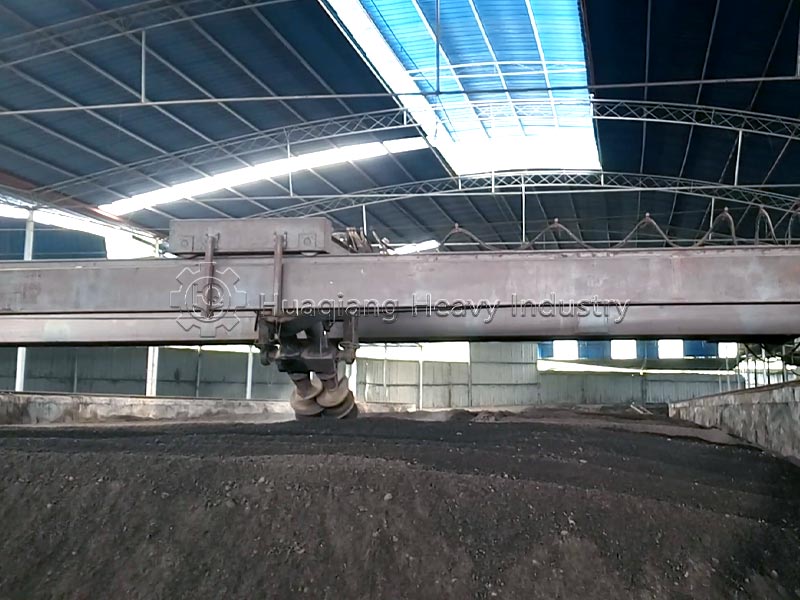
Furthermore, the turner transforms "composting" from a vague, experience-based practice into a precise, controllable process. Chicken manure often contains residual insect eggs and weed seeds, which can only be effectively neutralized by maintaining temperatures above 55°C for a sustained period. By using a turner in conjunction with temperature monitoring, operators can ensure the material remains in this high-temperature phase for the required duration before transitioning to the cooling stage, resulting in a uniform level of decomposition. In traditional static piling, the outer layers often fail to reach the necessary temperature, leading to an uneven, partially composted product. With a turner, the entire batch undergoes the same temperature profile, guaranteeing a safe, high-quality end product.
Most importantly, this technology enables chicken manure to move beyond "local disposal" toward "interregional distribution." Once properly composted and adjusted to an optimal moisture level, the manure becomes an organic fertilizer that is odorless, safe for crops, and easy to package and transport—making it a viable product for commercial growers. For livestock farms, chicken manure shifts from being a disposal cost to a source of sales revenue; for farmers, it provides an additional, nitrogen-rich organic fertilizer option.
The true value of a manure compost turning machine lies not in the machine itself, but in its ability to retain nutrients, ensure safety, and unlock the commercial potential of chicken manure. The transformation from an "odorous burden" into "black gold" begins with this very act of turning.