
Fertilizers for field crops are governed by a clear set of realities: high application volumes, concentrated seasonal demand, and high price sensitivity. These factors dictate the configuration of an NPK fertilizer production line: rather than prioritizing aesthetic perfection or complex, fancy formulations, the focus should be on production capacity, cost-efficiency, and stability during storage and transport.
High production capacity is essential. Because the window for field fertilization is narrow—with demand peaking during spring tillage and top-dressing periods—a production line sized based on average annual demand would inevitably lead to shortages during peak seasons. A sound approach is to calculate the required hourly output based on peak daily shipment volumes, while incorporating a 20% buffer. Rotary drum granulators, which excel at continuous, high-volume operation, are well-suited for such intensive production cycles.
High nutrient concentration is necessary to keep transportation costs manageable. Since field fertilizers are often transported over distances of a hundred kilometers or more, low-concentration products incur disproportionately high freight costs, rendering them uncompetitive in the final market. The production line should be capable of consistently producing fertilizers with a total nutrient content of at least 40%. Compaction (extrusion) granulation is highly effective for high-concentration formulations; it produces stable granules and eliminates the need for a drying stage, offering a significant advantage in energy efficiency. Conversely, drum granulation requires robust drying and cooling systems to ensure sufficient granule strength.
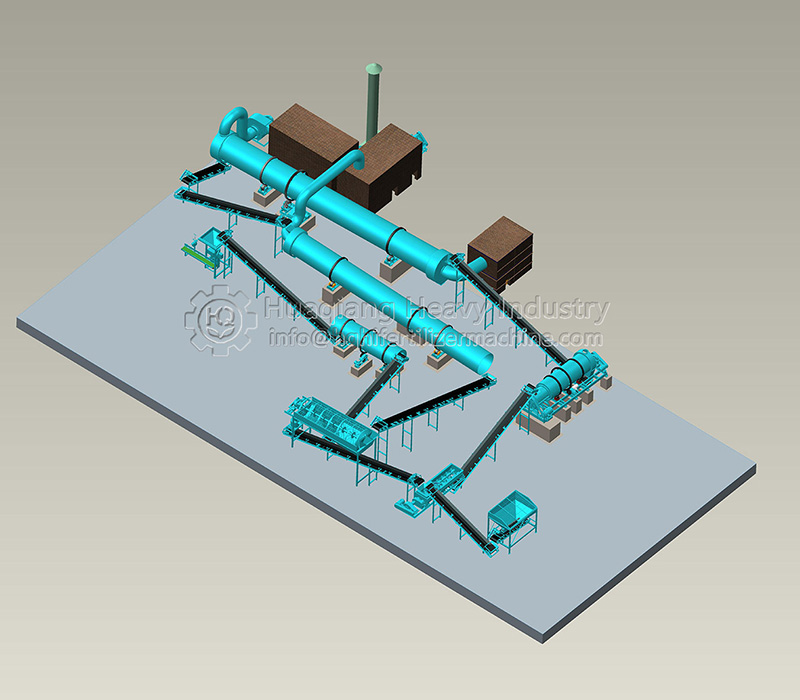
Granule strength is critical. Field fertilizers are typically applied using mechanical spreaders or seed drills; if the granules lack sufficient strength, they will crumble, leading to uneven distribution in the field. Drum-granulated particles become dense as they tumble, naturally resulting in high strength. Extruded granules, while often cylindrical in shape, are highly dense and resistant to impact.
Anti-caking measures are vital. Field fertilizers are often stored for long periods and stacked in high piles; if the granules absorb moisture and cake, it will almost certainly lead to product returns. The end of the production line must include cooling and coating stages. If the product is packaged without adequate cooling, residual heat can cause condensation inside the bags, making caking nearly unavoidable.
In short, the configuration logic for a field-crop fertilizer production line is derived by working backward from the field environment: the fertilization window determines production capacity; the transport radius dictates nutrient concentration; mechanical application requirements define the necessary granule strength; and the storage cycle dictates the need for anti-caking measures.