
Disc granulators are frequently adopted in NPK fertilizer production lines due to their simple structure and low investment costs. However, in actual operation, their limitations are far more pronounced than anticipated; a lack of proper assessment can easily lead to a scenario where granulation is possible, but the quality is poor.
First, high-concentration formulations are difficult to pelletize effectively. When the total NPK nutrient content exceeds 40%, the proportion of inorganic salts is extremely high; these salts exhibit high solubility and poor adhesiveness, making it difficult for the material to roll and agglomerate, often resulting in excessive fines or loose, fragile granules. Even with the addition of binders, granule strength often fails to meet standards, making the product prone to breakage during transport.
Second, the volume of recirculated material is substantial. The pelletization rate of disc granulators is generally lower than that of rotary drum or extrusion processes, requiring a large amount of ungranulated fines to be screened out and returned for reprocessing. This necessitates sizing auxiliary equipment—such as screens, crushers, and return conveyors—for higher throughput capacities, thereby increasing system complexity and energy consumption—a stark contrast to the initial impression of "low investment."
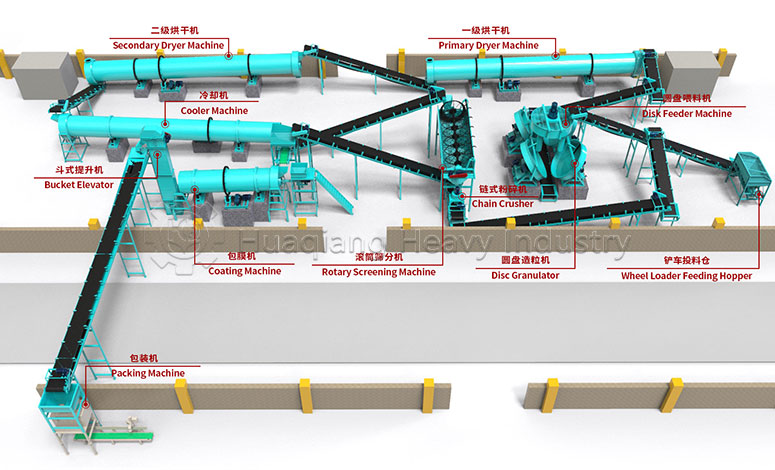
Third, scaling up the capacity of a single unit is challenging. Disc granulation technology relies on rolling action across the disc surface; as the disc diameter increases, it becomes difficult to uniformly control material residence time, leading to inconsistent granule sizes. Since the capacity of a single unit is limited, large-scale production requires multiple units operating in parallel, which drives up both land footprint and labor costs.
Fourth, granule uniformity is highly sensitive to operational fluctuations. Water spray volume, disc speed, and tilt angle must be precisely coordinated in real-time; a deviation in any parameter can cause significant fluctuations in granule size. NPK products have strict specifications regarding particle size, yet the stability of disc granulation relies heavily on operator experience, making standardized control difficult to achieve.
Disc granulators are not unusable; rather, they are ill-suited for NPK production scenarios requiring high concentrations, large-scale output, and strict particle size control. Recognizing these limitations is essential to avoid the long-term losses associated with selecting the wrong equipment.