
NPK fertilizer production process prioritizes nutrient precision and granule stability, with the granulation stage serving as a critical link between upstream and downstream processes. As a classic agglomeration device, the pan granulator holds a distinct place in this production line but also operates within clear limitations.
NPK raw materials—typically inorganic salts such as urea, monoammonium phosphate (MAP), and potassium chloride—are metered and mixed before entering the granulation stage. The pan granulator utilizes a rotating, inclined pan to cause materials to roll and agglomerate under the influence of centrifugal and frictional forces; simultaneously, water or steam is sprayed to adjust moisture levels, allowing the material to gradually form spherical granules. Its advantages include a simple structure, low investment costs, and the production of smooth, round granules, making it well-suited for small-to-medium-scale production of low-to-medium concentration NPK fertilizers.
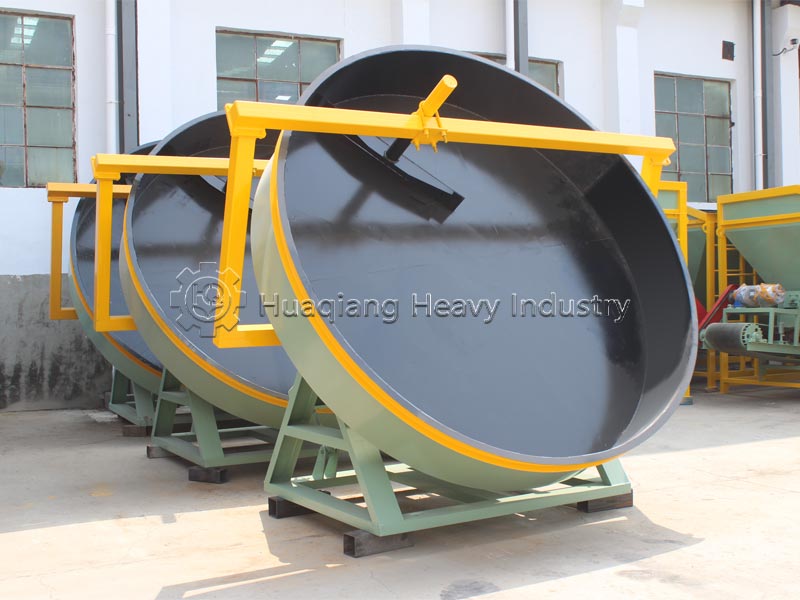
However, pan granulators are sensitive to NPK formulations. Inorganic salts generally exhibit poor granulation characteristics: high-nitrogen formulas are sticky and prone to caking, while high-potassium formulas resist agglomeration, often necessitating the addition of binders or recycled material for adjustment. When total nutrient content exceeds 40%, the high salt content and solubility of the materials make it difficult for pan granulation to achieve the desired granule strength; in such cases, rotary drum or extrusion granulation methods are more appropriate. Additionally, disc granulators typically have higher recycle rates than rotary drums, placing greater demands on the matching screening and crushing systems.
Successful operation hinges on three key factors: the pan's inclination angle and rotational speed determine material residence time and rolling trajectory; the water spray rate must be synchronized with the granulation speed (excessive water causes material to stick to the pan, while insufficient water leads to pulverization); and small amounts of humic acid or modified starch are often added during actual production to improve granulation performance.
The pan granulator is not a universal solution for NPK production lines. It is best suited for agglomeration processes involving low-to-medium concentrations and small-to-medium batch sizes, but it struggles in high-concentration, large-scale production scenarios. Recognizing these limitations is essential to maximizing the equipment's value.