
The NPK compound fertilizer industry has long been plagued by a persistent contradiction: as nutrient concentrations rise, the granulation process becomes increasingly difficult. High-concentration formulations contain a large proportion of inorganic salts, which causes granulation efficiency in rotary drum or pan granulators to plummet and the volume of recycled material to surge. Meanwhile, while high-tower melt granulation produces aesthetically pleasing, spherical granules, the high capital investment and energy consumption required effectively lock out small and medium-sized manufacturers. The double roller press granulator offers a new solution that bypasses these constraints.
It challenges the conventional wisdom that "high concentration necessitates massive investment." As a dry-forming process, roller pressing uses high pressure—rather than moisture or heat—to force materials into mold cavities at ambient temperature, eliminating the need for a drying stage. Consequently, the capital investment for a high-concentration NPK production line using this method is often just a fraction of that required for a high-tower or rotary drum line of equivalent capacity. This provides small and medium-sized enterprises with a gateway into the high-concentration product market, fostering greater diversity in the industry’s product structure.
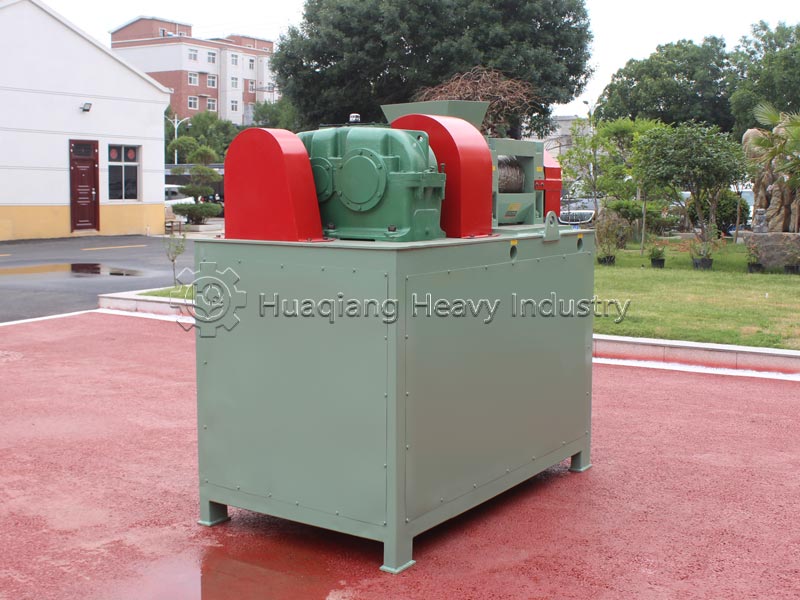
It restores flexibility in formulation to the production stage. Rotary drum and pan granulators are highly sensitive to material stickiness, requiring parameter recalibration whenever a formula is adjusted; high-tower granulation, meanwhile, imposes strict requirements on the thermal stability of raw materials. Because roller pressing does not rely on a liquid phase for granulation, it is far more tolerant of variations in the ratios of urea, ammonium phosphate, and potassium chloride—changing a formula simply requires adjusting the roller pressure and mold cavity settings.
It also presents a different environmental profile. Traditional production methods either involve burning fuel for drying or generate dust-laden exhaust gases. By eliminating the drying stage, roller press granulation significantly reduces the number of dust and exhaust emission points, thereby lowering the costs associated with environmental compliance.
Admittedly, granules produced via roller pressing tend to be cylindrical or flattened rather than perfectly spherical, which can affect their commercial appeal; furthermore, the rollers are subject to wear and require timely repair or replacement. Nevertheless, this technology lowers the barrier to entry for high-concentration NPK fertilizers, ensuring that manufacturers no longer have to choose between formulation flexibility and environmental compliance.