
When controlling BB fertilizer production costs, while raw material procurement is certainly important, the hidden losses occurring during the production process often warrant greater attention. Specifically, the proper selection of the BB fertilizer mixer directly impacts raw material loss, labor efficiency, and product quality.
BB fertilizer production involves the simplest process of any fertilizer type; however, precisely because the workflow is streamlined, quality control during the mixing stage becomes even more critical. Base fertilizer granules often differ significantly in size and specific gravity; if the mixer fails to distribute them evenly, granule segregation can occur during discharge, potentially leading to nutrient deviations exceeding 5%.
Currently, two types of mixers are most widely used in BB fertilizer production lines. The horizontal ribbon mixer utilizes inner and outer ribbons to agitate materials, achieving high mixing uniformity and keeping residual material below 0.3%. The twin-shaft zero-gravity mixer employs an interlaced paddle structure, offering rapid mixing speeds that allow a batch to be completed in mere seconds. Both types share the characteristic of low rotational speeds (20–40 rpm), which prevents high-speed agitation from crushing the base fertilizer granules.
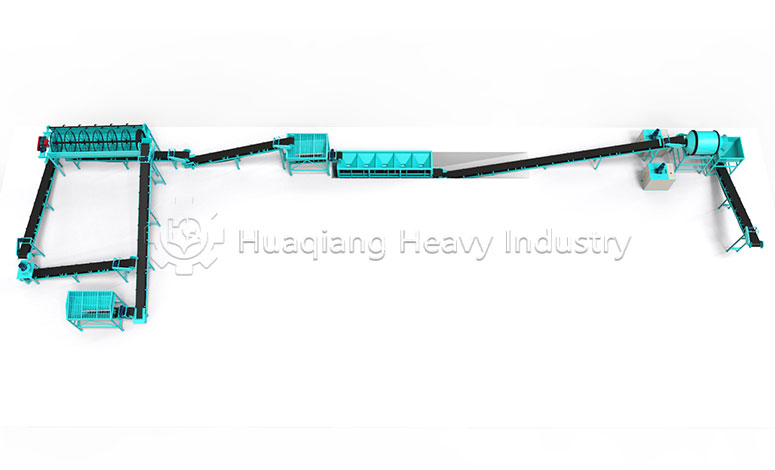
The impact of mixer selection on production costs manifests in three ways: fine powder generated by granule breakage during mixing becomes waste, increasing raw material loss; fully automated lines can reduce the workforce by four operators per shift, significantly cutting labor costs; and failure to meet mixing uniformity standards necessitates downgrading or reworking the entire batch. Furthermore, the mixer's batch capacity must align with the pacing of the batching and packaging stages.
In summary, controlling BB fertilizer production costs requires looking beyond raw material purchase prices. A suitable BB fertilizer mixer, combined with synchronized batching and packaging rhythms, is the key to ensuring the entire production line operates with minimal loss and maximum efficiency.