
Inside a fertilizer plant in Vietnam, the main unit of a double-cage crusher has been positioned, and installation technicians are carefully inspecting the equipment’s sealing and anti-corrosion features. The line is designed to process diammonium phosphate (DAP) granules—a material that is both hard and highly hygroscopic. Given the local climate, characterized by high temperatures and high humidity, the installation process requires attention to far more than just leveling and anchor-bolt security.
The first priority is moisture protection. DAP granules readily absorb moisture and clump together when exposed to hot, humid air. If the crushing chamber or the feed and discharge ports are not perfectly sealed, material trapped inside will absorb moisture and quickly clog the cage assembly. During installation, acid-resistant rubber gaskets are fitted to all flange connections, and the inclines of the feed and discharge chutes are steepened to minimize "dead zones" where material might accumulate. Additionally, a ventilation gap is maintained between the equipment base and the floor to prevent moisture from rising from the ground.
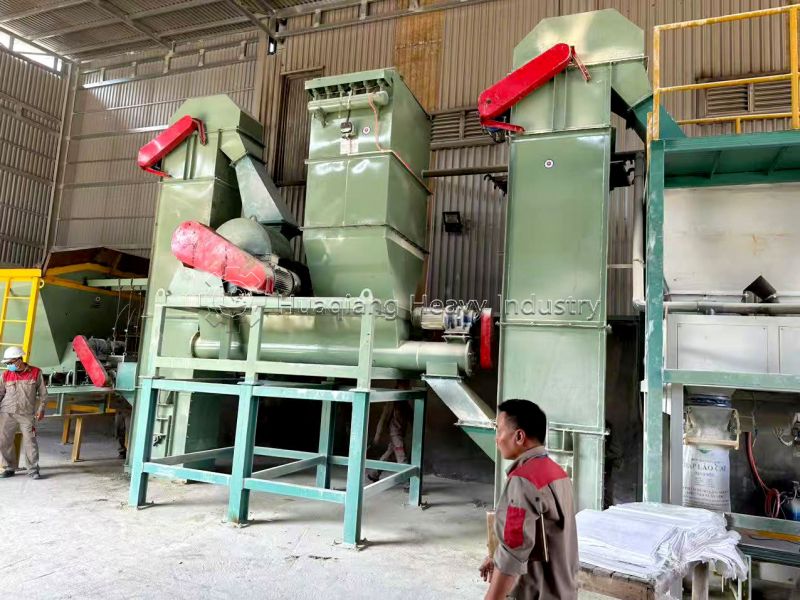
The second priority is corrosion resistance. DAP is weakly acidic and corrosive to standard carbon steel. Consequently, the cage assemblies and tooth plates—components that come into direct contact with the material—are made of stainless steel. During installation, special care is taken to ensure that all welds are properly ground and passivated; any residual welding slag can serve as a starting point for corrosion. All fasteners are also replaced with stainless steel equivalents to prevent standard bolts from rusting shut, which would otherwise complicate future maintenance.
The third priority is the alignment of the dual cages. A double-cage crusher relies on two rotors spinning in opposite directions to break down the material, and the gap between the cages directly determines the fineness of the output. Technicians use feeler gauges to take measurements at multiple points, ensuring the gap is uniform along the entire axial length. Furthermore, the rotation direction of the rotors is verified against the material flow; if installed in reverse, the crushing efficiency would suffer, and the cage assemblies would experience accelerated wear.
During the trial run, a small batch of DAP granules is processed to check the output fineness and monitor the equipment for any abnormal vibrations. While additional dehumidification equipment will be required later—given Vietnam’s long rainy season—ensuring robust sealing, corrosion protection, and precise alignment during the installation phase lays a solid foundation for the equipment’s stable operation in this hot, humid environment.