
At the straw processing center in Datong Town, Jiande, the fermentation bays have taken shape. The main body of the chain-plate compost turner has just been hoisted into position, and the installation team is currently calibrating the elevation and span of the rails, section by section.
The project is designed to process 20,000 to 30,000 cubic meters of straw (in both dry and wet states) annually, producing organic fertilizer and seedling-raising substrates. Because straw is highly fibrous, loose in texture, and has a low nutrient density per unit volume, the civil engineering costs must be amortized over a large volume of material; consequently, the fermentation bays are designed to be 1.8 to 2.5 meters deep—deeper than those typically used for manure or sludge. With this increased depth, the vertical lifting capacity of the chain plates and the trajectory of the discharged material become critical installation priorities. The material must be lifted to a sufficient height and dispersed to ensure full contact with the air, which helps overcome the challenge of a slow start to the straw fermentation process.
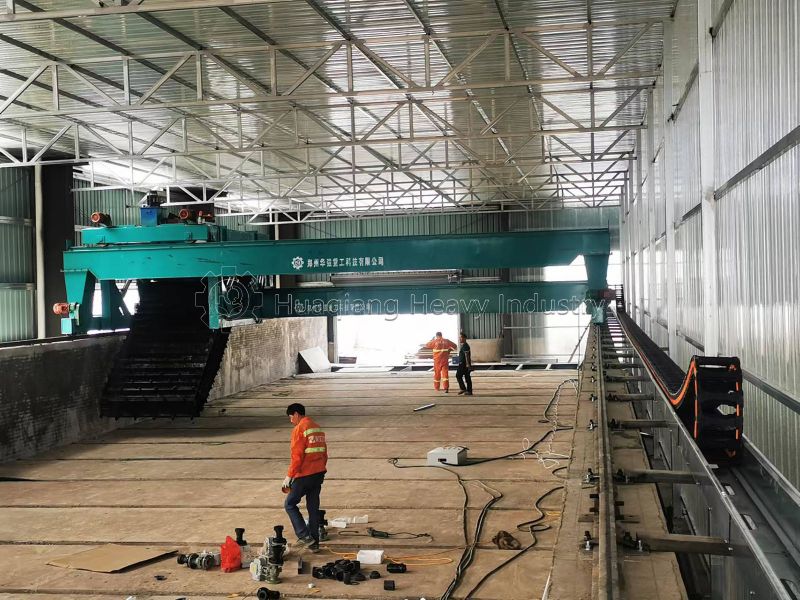
One detail easily overlooked on-site is the flatness of the bay walls. If the walls have protrusions or if corners lack smooth, rounded transitions, the moving chain-plate assembly could collide with the gear shafts or create "dead zones" where material cannot be cleared. The installation team inspects the walls section by section and ensures that the wear-resistant liners are properly seated. Proper grounding of the rails is also essential—it is the fundamental requirement for safe operation.
A no-load test run is the final, crucial step: the direction of the chain-plate rotation must align with the arrows on the equipment labels, and the travel system must be tested through back-and-forth movement to check for rail binding or misalignment. Given the loose, low-density nature of straw, the depth of material intake and the travel speed must be fine-tuned during load testing—ensuring the material is turned thoroughly without wasting energy through unnecessary idling.
The installation process largely consists of repeated, meticulous checks of elevations, spans, grounding, and rotational directions. The true value of a chain-plate compost turner lies precisely in these seemingly mundane calibrations; only when the equipment is perfectly integrated with the fermentation bays can one ensure uniform fermentation and consistent material discharge during subsequent operations.