
A set of roller press granulator production lines customized by our company for a Bolivian client has recently completed all modifications and packaging, and has been shipped in four containers. This batch of equipment will be used for compound fertilizer production in the local area. Considering the working conditions in the La Paz area of Bolivia, at an altitude of over 3600 meters, the technical department made several adaptation adjustments based on the standard model.
Regarding the electrical system, the main motor was reselected according to the high-altitude derating factor, the cooling fan airflow was increased, and the creepage distance of components in the control cabinet was increased to avoid the risk of creepage breakdown under low air pressure. A pressure compensation valve was added to the hydraulic system of the compactor to ensure stable pressure maintenance under thin air conditions; all reducer oil seals were replaced with high and low temperature resistant silicone material to cope with the large temperature difference between day and night in the area. During the production phase, the entire line underwent continuous testing simulating a high-altitude air pressure environment, and the extrusion roller speed, crusher frequency, and screening efficiency all met design requirements.
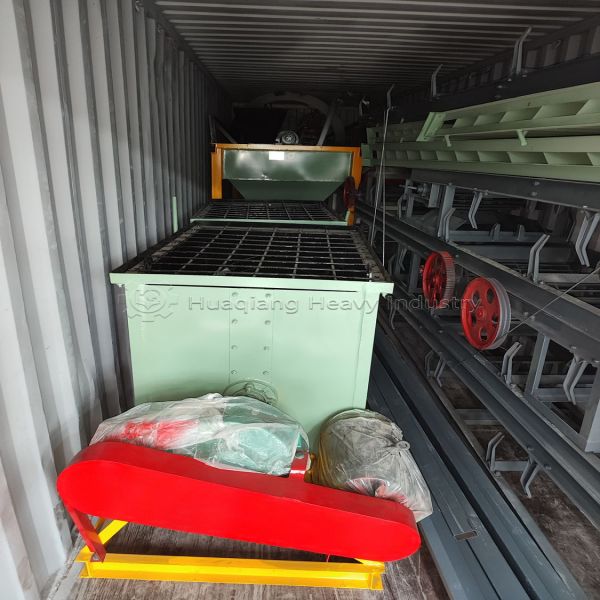
Packaging was also reinforced for long-distance sea-land intermodal transport: the main unit was disassembled into four parts: the roller pressing assembly, the crushing assembly, the screening assembly, and the base. Each part was secured with steel brackets, and exposed machined surfaces were coated with anti-rust oil and wrapped with aluminum foil composite film. The entire interior of the electrical control cabinet was reinforced with glue, and the cabinet was fitted with moisture-proof padding and tamper-evident cable ties. The four containers were loaded according to the center of gravity distribution plan, and all passed the off-center load test on the first attempt.
The goods will be shipped to the port of Arica, Chile, and then transshipped overland to Bolivia. Accompanying documents include Spanish-language installation diagrams and operation manuals; customs clearance procedures have been completed.