
Although the final products of both BB fertilizer and NPK compound fertilizer contain nitrogen, phosphorus, and potassium, their production logics differ drastically. Understanding this distinction is crucial when planning the product mix and equipment configuration for an NPK fertilizer plant.
BB fertilizer production process is essentially a process of "physical blending." Granular straight fertilizers (nitrogen, phosphorus, and potassium) are produced separately and then mechanically mixed in specific proportions according to a formula. The entire process requires no water, steam, granulation, or drying; the core setup consists simply of a mixer, a batching system, and a packaging scale. Formulas can be adjusted at any time, making it ideal for small-batch, multi-variety, and customized production scenarios.
NPK fertilizer manufacturing process, in contrast, relies on "chemical synthesis." Raw materials are fused through chemical reactions and then processed into uniform granules via multiple stages—including granulation, drying, cooling, and screening. Each granule contains an identical nutrient composition, making it suitable for large-scale, standardized production. However, once a formula is set, the cost of adjusting it is extremely high.
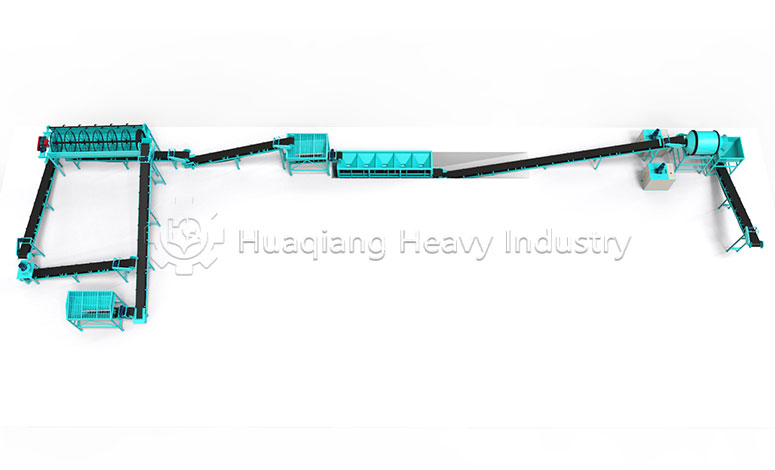
In terms of plant configuration, the two production lines differ significantly. An NPK compound fertilizer line requires heavy equipment such as crushers, granulators, dryers, coolers, and hot-blast stoves; it typically occupies a facility area of over 1,000 square meters and requires an investment 6 to 10 times higher than that of a BB fertilizer line. Regarding energy consumption, BB fertilizer production avoids high-temperature granulation and drying, resulting in an energy use of only 2.8–4.5 kWh per ton; conversely, NPK compound fertilizer lines consume 18–25 kWh per ton due to the drying process.
The flexibility of BB fertilizer offers distinct advantages in soil-test-based fertilization and customized applications, whereas the nutrient uniformity of NPK compound fertilizer makes it the dominant choice for large-scale field cultivation. These two processes cater to different market needs; understanding their fundamental differences is essential for making the right choice during project planning.