
The production of diammonium phosphate (DAP) granules imposes requirements on equipment that differ significantly from those for standard organic or blended fertilizers. DAP contains free acid, is highly corrosive, exhibits high hygroscopicity, and produces brittle granules. Consequently, equipment selection cannot be based merely on basic functionality—such as the ability to rotate or granulate—but must instead be strictly dictated by the specific characteristics of the material.
The first requirement is corrosion resistance. The corrosive environment in DAP production varies across the process: the intensity of corrosion is highest at the phosphoric acid feed stage, followed by the neutralization/granulation stage, and decreases through the drying and cooling zones. While 316L stainless steel is suitable for areas involving dilute acids or lower temperatures, environments with high-temperature concentrated acids—or those containing significant levels of fluorine or chlorine impurities—require materials such as 317L, Alloy 20, or duplex stainless steel 2205 to provide adequate resistance to pitting and crevice corrosion. For large components like granulation drums, lining the interior with wear-resistant rubber or acid-resistant stainless steel plates is a common approach to balancing cost and service life. Choosing the wrong material may not cause an immediate shutdown; instead, it leads to a gradual thinning of wall thickness and the deterioration of welds, eventually resulting in an unplanned production stoppage.
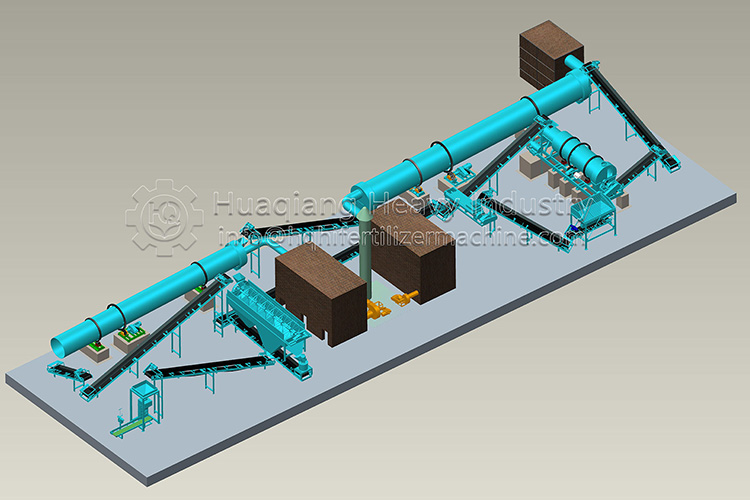
The second requirement is wear resistance. DAP granules are relatively hard, causing continuous abrasion during conveying, screening, and crushing. Liners, chutes, and screens should be constructed from wear-resistant alloys or polymer-based materials, while excessive material flow velocities and drop heights must be avoided.
The third requirement is comprehensive sealing and moisture protection throughout the entire process. Because DAP is highly prone to caking when it absorbs moisture, storage silos, conveying pipelines, and packaging stations should utilize moisture-proof feeders and stainless steel piping with polished interior surfaces to minimize material adhesion and moisture ingress. Furthermore, as DAP dust is combustible, areas prone to dust generation—such as screening and packaging stations—must comply with explosion-proof standards, incorporating features like anti-static linings, explosion relief vents, and spark detection systems.
Ultimately, the core of selecting equipment for DAP production lies in achieving a balance—tailored to the specific operating conditions—between corrosion resistance, wear resistance, moisture control, and safety. Only by withstanding these four types of constraints can a fertilizer production line be considered truly continuous and stable.