
The production processes and core requirements for organic fertilizers versus bio-organic fertilizers differ significantly, and their corresponding production equipment reflects these fundamental distinctions. The primary difference lies in the fact that bio-organic fertilizer equipment must additionally accommodate the cultivation of microbial strains and the preservation of their biological activity, whereas organic fertilizer production equipment focuses primarily on raw material processing and product granulation.
In terms of equipment configuration, a standard organic fertilizer production line consists mainly of fermentation machinery, crushing and screening units, granulators, and dryers. It features a simple structure and requires no specialized temperature control or sterile facilities; its sole requirement is to facilitate the proper decomposition (maturation) and shaping of the raw materials.
Bio-organic fertilizer equipment, building upon this foundation, incorporates additional components such as microbial culture incubators, temperature-controlled fermentation tanks, and sterile inoculation systems. Its core function is to provide an optimal environment for microbial cultivation—thereby preventing the deactivation of the microbial strains—and it necessitates the installation of specialized devices for precise temperature and humidity control.
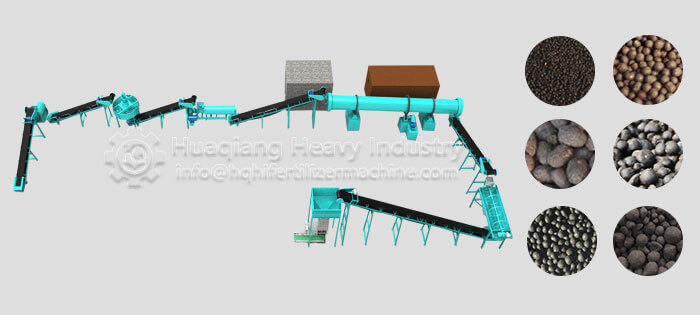
Regarding process requirements, organic fertilizer equipment operates under relatively lenient parameters for fermentation temperature and humidity, requires no sterile environment, and simply needs to ensure the complete decomposition of the raw materials. Bio-organic fertilizer equipment, conversely, demands strict control over fermentation parameters, requires a sterile environment throughout the entire process, and mandates low-temperature operation during the drying phase to prevent compromising the biological activity of the microbial strains.
In terms of application scenarios, organic fertilizer equipment is well-suited for the large-scale production of general-purpose organic fertilizers, whereas bio-organic fertilizer equipment is designed for high-end bio-organic fertilizers and is tailored to cultivation environments where the biological activity of the fertilizer is a critical requirement. Neither type of equipment is inherently superior to the other; the appropriate choice depends entirely on the specific positioning and requirements of the intended fertilizer product.