
NPK compound fertilizers, due to their adjustable nutrient ratios and ease of application, are one of the most widely used fertilizer categories globally. Understanding NPK fertilizer production technology requires a systematic understanding of everything from process selection to the design of the entire NPK fertilizer plant. Currently, there are three main processes for production of npk fertilizer.
Rotary Drum granulation is the most traditional method. Nitrogen, phosphorus, and potassium base fertilizers are mixed and granulated using steam within a rotating drum, followed by drying and sieving. This process is highly adaptable to raw materials and suitable for medium to low concentration compound fertilizers, but it has high drying energy consumption.
Melting granulation (high-tower granulation) represents a more advanced approach. Nitrogen sources such as urea are heated and melted, mixed with phosphorus and potassium to form a slurry, and sprayed from the top of a high tower. The droplets naturally cool and solidify into smooth, round granules. The high-tower process eliminates the need for subsequent drying, significantly reducing energy consumption. The granules are round and do not caking, making it suitable for high-concentration products, but it has higher investment costs and is best suited for large-scale factory production.
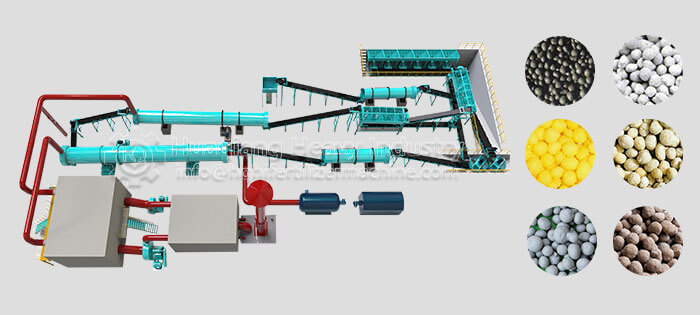
The third method is blending, which involves directly mixing granular nitrogen, phosphorus, and potassium raw materials without granulation. This is the simplest and lowest-cost process, but it requires the base fertilizer particles to be of similar size; otherwise, segregation is likely. Blending is suitable for small-batch, customized orders. In actual production, many factories combine multiple processes based on market demand: high-tower lines focus on high-end products, rotary drum lines produce general-purpose fertilizers, and blending lines meet flexible formulation needs.
Modern NPK fertilizer production technology is developing towards energy conservation and intelligence. Low-temperature hot air drying can reduce energy consumption by more than 20%, and online near-infrared analyzers can monitor nutrients in real time and automatically adjust the batching. For companies planning to build or upgrade NPK plants, the core recommendation is to select the dominant process based on target capacity and product positioning, prioritizing batching accuracy. A successful NPK fertilizer plant is often the result of multiple processes working together, rather than the pinnacle of a single technology.