
Controlling BB fertilizer production costs is crucial for fertilizer companies' profitability. While raw material prices are difficult to control, labor, energy consumption, and material losses in the processing stage can be significantly reduced through technological upgrades.
Many manufacturers focus solely on the purchase price of nitrogen, phosphorus, and potassium (NPK), neglecting the "hidden losses" in the mixing and packaging stages. Uneven raw material particle size easily leads to segregation, resulting in nutrient deviations in the finished product that necessitate rework or price reductions. Traditional weighing methods lack precision; adding even 0.5% more raw material per ton results in the loss of hundreds of tons of fertilizer with an annual production capacity of 50,000 tons. These pain points are precisely what efficient equipment can address.
An advanced bulk blending fertilizer machine can bring immediate cost savings. Taking a zero-gravity twin-shaft paddle mixer as an example, the coefficient of variation for mixing uniformity can be controlled within 7%, avoiding the energy consumption caused by repeated mixing; the residual rate is less than 0.5%, reducing material adhesion and waste; the mixing cycle is only 1-2 minutes, completing more batches in the same time and amortizing fixed costs. A workshop with a daily output of 100 tons can save 20,000-30,000 yuan annually simply by reducing raw material loss.
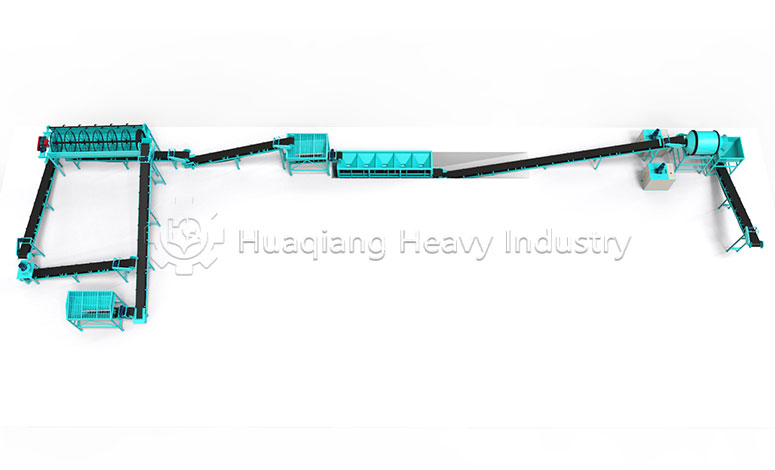
While single-machine optimization has its limits, a complete BB fertilizer production line can achieve systemic cost control. Modern production lines integrate automated batching, mixing, packaging, and dust removal units. With PLC control, only 2-3 people are needed for inspection per line, reducing the number of operators by 5-6 compared to the traditional model, saving 150,000-200,000 yuan in labor costs annually. Loss-in-weight batching scales control the error within ±0.2%, eliminating the "better too much than too little" habit, saving 0.3-0.5 kg of raw materials per ton. Continuous operation eliminates waiting time, increasing capacity by 20%-30% and reducing unit power consumption. The dust removal system recovers dust, reducing material loss and avoiding environmental penalties.
Comprehensive calculations show that a 50,000-ton-per-year BB fertilizer production line, by upgrading the mixing machines and optimizing the entire process, can reduce costs per ton by approximately 6.5 yuan, including raw materials, labor, and energy, resulting in annual savings of 325,000 yuan. To reduce the production cost of BB fertilizers, we cannot only focus on raw material prices; we must also seek efficiency improvements in the mixing and packaging processes. Selecting suitable bulk mixing machinery and building an efficient production line is an essential step in moving from extensive to lean production methods.