
The NPK manufacturing process is a standardized industrial system for producing balanced nitrogen, phosphorus, and potassium fertilizers. The manufacturing of NPK fertilizer prioritizes precise nutrient proportioning, stable physical characteristics and high crop absorption efficiency, serving as the core of modern fertilizer industrialization. Every mature NPK fertilizer manufacturing process adheres to standard operational logic, covering complete procedures from raw material processing to finished product inspection.
Raw material pretreatment acts as the foundation of qualified NPK fertilizer production. All nitrogen, phosphorus and potassium raw materials must undergo strict screening, impurity removal and crushing before production. Oversized and agglomerated materials are processed into uniform powder or particles to maintain stable material activity. This essential step prevents uneven nutrient distribution and equipment failure, ensuring accurate batching and smooth molding in subsequent procedures.
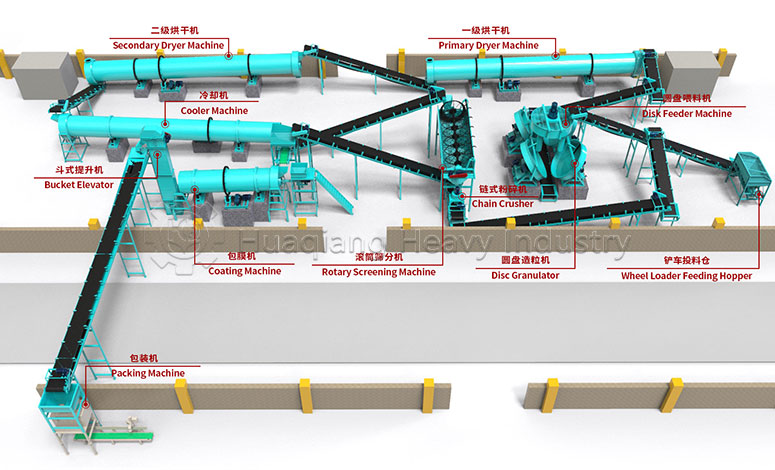
Precision batching and molding constitute the core of the entire production workflow. Based on soil conditions and crop nutrient demands, automated equipment weighs raw materials to achieve accurate formula matching. For compound NPK fertilizers, mixed raw materials are humidified and granulated to realize tight molecular fusion of multiple nutrients, directly deciding the finished fertilizer’s nutrient stability and water solubility.
Post-processing and quality calibration ensure commercial-grade fertilizer quality. Freshly granulated particles are dried and cooled to lower moisture content, avoiding caking and deterioration. Graded screening removes unqualified powder and deformed particles, while qualified products can be coated to enhance anti-caking performance and storage durability before final packaging.
To conclude, the core of the NPK fertilizer manufacturing process lies in precise proportioning and standardized processing. Strict implementation of every production step greatly improves fertilizer utilization efficiency, delivers consistent fertilization effects, and satisfies the demands of large-scale, standardized modern agricultural production.