
While both NPK fertilizer manufacturing process and organic fertilizer production ultimately produce fertilizers, their process logic, equipment configuration, and production goals are drastically different.
NPK compound fertilizer production revolves around "precise proportioning." Its process route uses rotary drum granulation, high-tower melting, or extrusion granulation to process powdered nitrogen, phosphorus, and potassium raw materials into granules. The entire NPK fertilizer production line encompasses multiple processes, involving numerous pieces of equipment and a long workflow. Taking a rotary drum granulation line as an example, a single machine can achieve a capacity of 10-20 tons/hour, suitable for large-scale continuous production. The core equipment is the granulator, and the entire process revolves around "how to transform powder into uniform granules," requiring extremely high precision in raw material fineness and formulation.
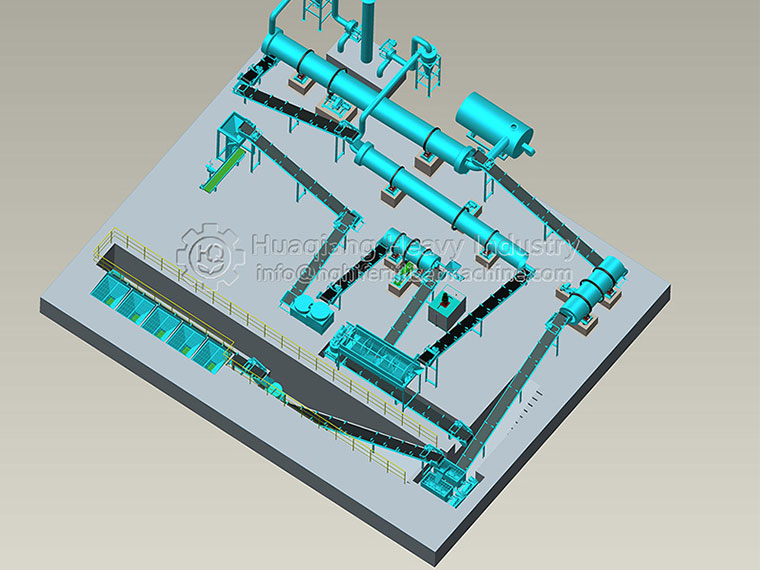
Organic fertilizer production process, on the other hand, focuses on "bioconversion." The process primarily revolves around aerobic fermentation—livestock manure, straw, and other waste materials are regularly turned over by a turning machine, undergoing 15-25 days of thorough decomposition. Organic matter is transformed into stable humus, and pathogens are killed by high temperatures. After decomposition, the materials are crushed, mixed, granulated, and dried at low temperatures to become commercial organic fertilizer. The core equipment of the entire organic fertilizer production line is the turning machine. The entire process revolves around "how to make microorganisms work efficiently," requiring high standards for the carbon-to-nitrogen ratio, moisture content, and turning frequency of the materials.
Selection Recommendations: For NPK compound fertilizer production, choose a production line centered on a granulator, focusing on batching accuracy and molding rate; for organic fertilizer production, choose a fermentation line centered on a turning machine, focusing on the degree of decomposition and organic matter content. These two processes serve different market positioning; the key to selection lies in clearly defining product objectives and raw material conditions.