
NPK blending fertilizer production lines (BB fertilizer production lines) are known for their flexible formulations and low investment costs; however, as the process relies on physical mixing, it is not suitable for every fertilizer plant.
1. Plants producing high-concentration formulas or those containing organic matter. BB fertilizer nutrients are derived entirely from individual granular raw materials; the total nutrient content rarely exceeds 50%, and it is impossible to incorporate organic matter, microbial agents, or chelated secondary and trace elements. If the product is positioned as an organic-inorganic compound fertilizer or a high-concentration specialty fertilizer, a blending line is inadequate; chemical synthesis or organic granulation routes must be adopted instead.
2. Plants dealing with raw materials that vary significantly in particle size and specific gravity. Physical mixing does not alter particle morphology. If there are vast differences in the particle size and density of urea, potash, and phosphate fertilizers, segregation (separation of ingredients) easily occurs during transport and handling. This leads to uneven nutrient distribution in the field and high rates of product complaints.
3. Plants requiring high granule strength and suitability for long-distance transport. BB fertilizer granules lack inter-particle bonding; their strength depends solely on the raw materials themselves. Consequently, the rate of pulverization is high after long-distance transport, significantly compromising the product's commercial appeal. It is not an ideal choice for markets requiring long-distance distribution or involving multiple transport stages.
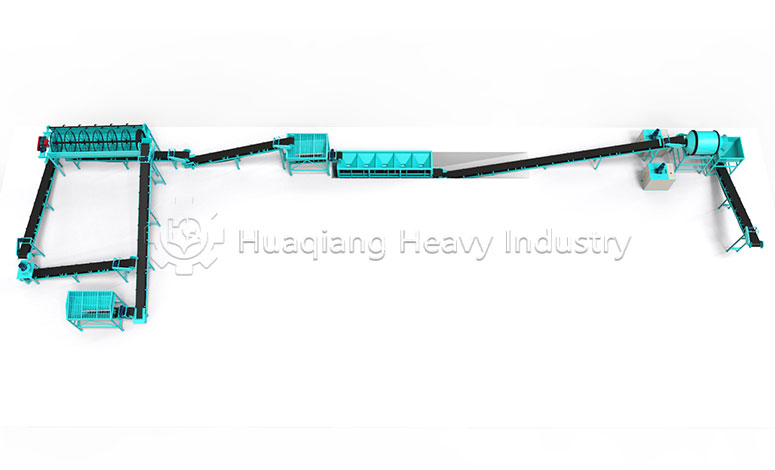
4. Plants lacking capabilities for precise batching and segregation prevention. While blending lines appear simple, they actually demand extremely high precision in batching, mixing uniformity, and anti-segregation design. Lax management can lead to significant nutrient fluctuations between batches and even trigger quality disputes.
5. Plants planning to produce slow/controlled-release fertilizers or coated fertilizers. Blending is merely a mixing process and cannot achieve coating or slow-release functionalities; if the product requires such functional attributes, an alternative technical route must be chosen.
NPK blending lines are best suited for scenarios involving flexible formulations, standardized raw material specifications, and short transport distances. If the product is positioned for high concentration, organic content, functional properties, or long-distance distribution, a careful assessment is necessary to avoid the long-term losses associated with a mismatch between equipment and product requirements.