
Both NPK blended fertilizer and NPK compound fertilizer contain nitrogen, phosphorus, and potassium nutrients and are commonly used in agricultural planting. They are processed and produced by NPK blending fertilizer production lines and NPK fertilizer production lines, respectively, but they differ significantly in their processes, characteristics, and applicable scenarios.
The core difference lies in the production process: NPK blended fertilizer is produced by a blending fertilizer production line using a physical mixing process, mixing nitrogen, phosphorus, and potassium single-element fertilizers and auxiliary materials in a specific ratio. The process is simple and the proportions can be flexibly adjusted. NPK compound fertilizer is processed by a fertilizer production line using a chemical synthesis process, fusing nutrients into single granules. The process is complex, and the proportions are fixed and cannot be adjusted.
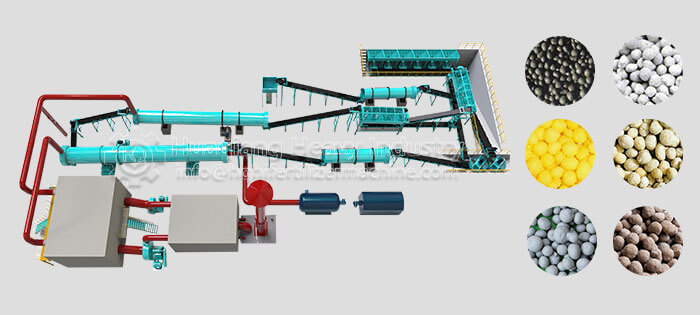
Secondly, there is the nutrient uniformity: Blended fertilizers are physically mixed, so the nutrients between granules may be uneven, requiring thorough stirring. Compound fertilizers are chemically synthesized, resulting in consistent nutrient content in each granule, with higher uniformity, requiring no additional stirring.
The applicable scenarios also differ: blending fertilizer production lines allow for flexible adjustments to the mixing ratio, adapting to diverse and personalized planting needs; NPK compound fertilizer production lines produce fertilizers with fixed ratios, offering strong versatility, suitability for field crops, and convenient application.
In summary, the core difference between the two lies in their production processes, which also determine the characteristics of each production line. When choosing, one can flexibly select based on planting needs, crop characteristics, and the output characteristics of the two production lines.