
With its core advantages of inclined conveying, small footprint, and high efficiency, large angle belt conveyors are widely used in fertilizer processing, especially suitable for scenarios requiring solutions to height differences and limited space. Specific suitable scenarios are as follows:
Suitable for connecting fertilizer production lines with significant height differences. In fertilizer processing, processes such as granulation and drying often involve height differences. Large angle belt conveyors can directly achieve inclined conveying, eliminating the need for multiple transfers and avoiding material loss and process disruptions.
Suitable for small and medium-sized fertilizer processing plants with limited space. These plants have compact spaces, and ordinary horizontal belt conveyors occupy a large area. Large angle belt conveyors can utilize vertical space, significantly saving space and eliminating the need for additional site expansion.
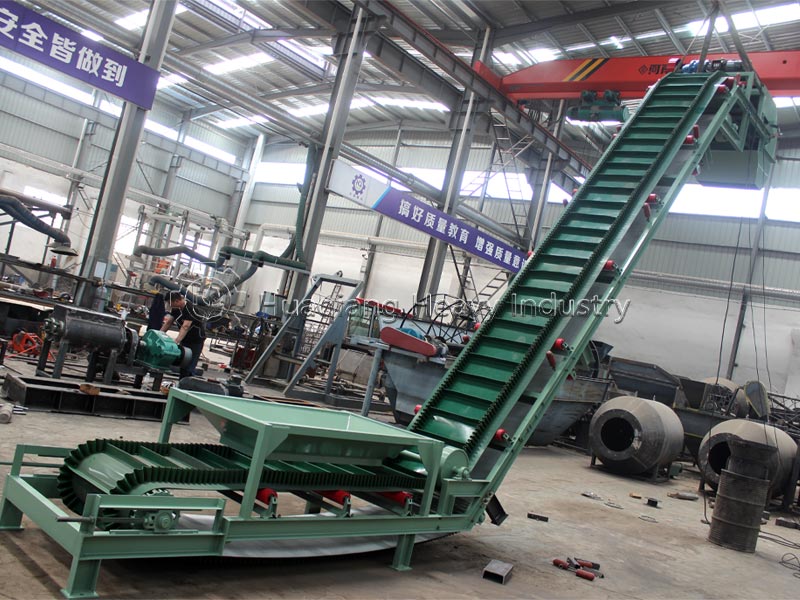
Suitable for transferring bulk fertilizers. Whether it's NPK compound fertilizer raw materials, organic fertilizer semi-finished products, or finished fertilizer loading, it can continuously and efficiently convey materials. Its anti-scattering design reduces material waste and is suitable for batch production needs.
Suitable for transferring bulk fertilizers. In summary, the large angle belt conveyor is suitable for three types of scenarios: high and low elevation differences, limited space, and bulk transportation. It meets the needs of each process in fertilizer processing, improves efficiency, and saves costs, making it a practical piece of equipment for fertilizer processing plants.