
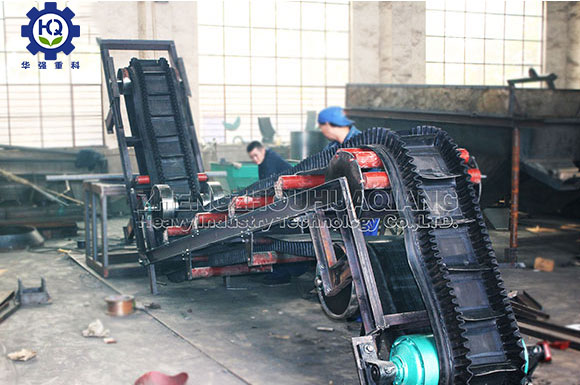

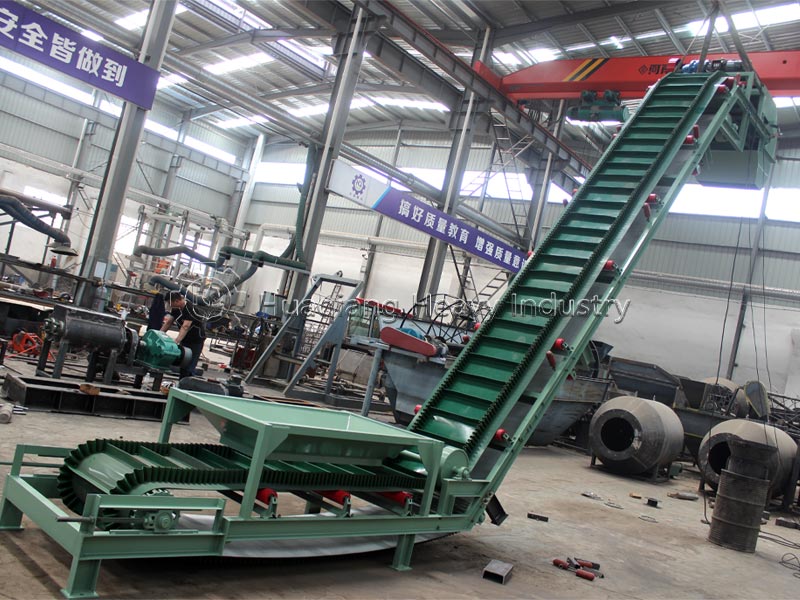
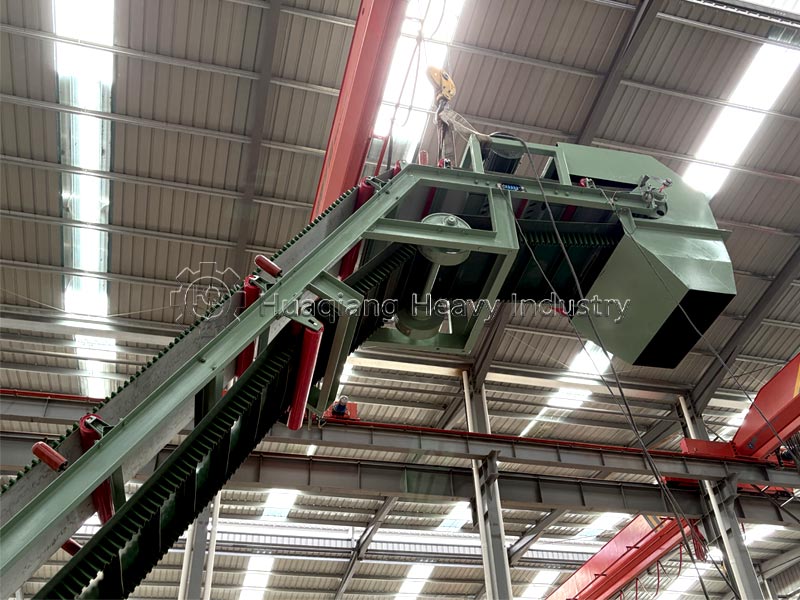
The large angle belt conveyor is specialized equipment used in the fertilizer industry to transport materials from a lower to a higher elevation at a steep angle. It utilizes a special conveyor belt featuring corrugated sidewalls and transverse cleats, enabling the smooth elevation of powdery, granular, or small lump materials to a designated height at angles ranging from 30° to 90°. Unlike standard belt conveyors limited to shallow inclines, this equipment achieves vertical or near-vertical lifting within a compact footprint, significantly shortening the conveying distance and saving factory floor space. Characterized by stable operation and high conveying capacity, it serves as an efficient vertical transfer unit connecting equipment across different levels in organic and compound fertilizer production lines.
Working Principle
Material enters the conveyor belt through the inlet at the horizontal section; the belt surface is equipped with corrugated sidewalls and transverse cleats, forming a series of small hopper-like compartments. The drive pulley propels the belt, and the material—supported by the transverse cleats—is lifted upward along the inclined section. The corrugated sidewalls prevent spillage from the sides, while the transverse cleats provide the upward thrust needed to overcome the material's weight. Upon reaching the top, as the belt wraps around the head pulley to change direction, the material is discharged through the outlet under the combined influence of centrifugal force and gravity. The belt then loops back around the tail pulley, creating a continuous conveying cycle.
Equipment Components
Corrugated Sidewall Conveyor Belt: An integrated unit vulcanized from three parts—the base belt, corrugated sidewalls, and transverse cleats; sidewall height and cleat spacing are designed based on conveying capacity and inclination angle.
Drive Unit: A motor drives the head pulley via a gearbox to operate the conveyor belt; power requirements are calculated based on lifting height and conveying capacity.
Head and Tail Pulleys: The head pulley serves as the drive pulley and is rubber-lagged to increase friction; the tail pulley functions as the redirection and tensioning pulley.
Frame: A welded structural steel framework comprising inclined and horizontal sections to support the conveyor belt and idlers.
Idlers and Hold-down Wheels: Impact idlers are used on the load-carrying section, while hold-down wheels are installed on the return section to prevent belt deviation and lifting.
Tensioning Device: Uses screw or gravity tensioning mechanisms to ensure sufficient belt tension and prevent slippage.
Inlet and Discharge Hoppers: The inlet hopper features a material guide chute, while the discharge hopper connects to the feed inlet of downstream equipment.
Belt Cleaners: Installed at both the head and tail ends to remove material adhering to the belt surface.
Performance Characteristics
Large Lifting Angle: Capable of conveying at any angle between 30° and 90°, including vertical lifting.
Small Footprint: Replaces long inclined galleries, saving factory floor space and reducing civil engineering costs.
High Conveying Capacity: Belt width and speed can be customized; hourly capacity ranges from a few tons to over a hundred tons.
Enclosed Conveying: Dust covers can be added for fully enclosed operation, controlling the spread of dust and odors.
Stable Operation: Corrugated sidewalls and transverse cleats keep material stable on the belt without rolling off; low noise operation.
Wide Material Adaptability: Suitable for conveying powders, granules, small lumps, and semi-wet materials.