For the same production capacity, the investment and operating costs of an NPK fertilizer production line are generally significantly higher than those of an organic fertilizer production line. However, "higher" does not necessarily mean "less profitable"—the two have distinct cost structures rooted in entirely different product logics.
The primary difference stems from raw materials. Organic fertilizer production relies on inputs like livestock manure, crop straw, and fungal residue—materials that are extremely inexpensive to procure; in some cases, the process even serves as a method for waste disposal. In contrast, NPK production requires the external purchase of industrial raw materials such as urea, monoammonium phosphate (MAP), and potassium chloride. These materials carry higher unit prices that fluctuate with market conditions, and they often account for over 60% of the total production cost.
Differences in process complexity also drive a gap in equipment investment. An organic fertilizer line—even one producing granules with an annual capacity of 10,000 tons—requires relatively simple machinery, such as fermentation turners, crushers, mixers, and packaging equipment, with an investment typically in the range of hundreds of thousands of yuan. An NPK line, however, necessitates sophisticated equipment for precise batching, granulation, drying, cooling, screening, and coating. This entails more demanding requirements for facility layout, corrosion-resistant materials, and automation, often resulting in equipment investment costs several times higher than those for an organic fertilizer line.
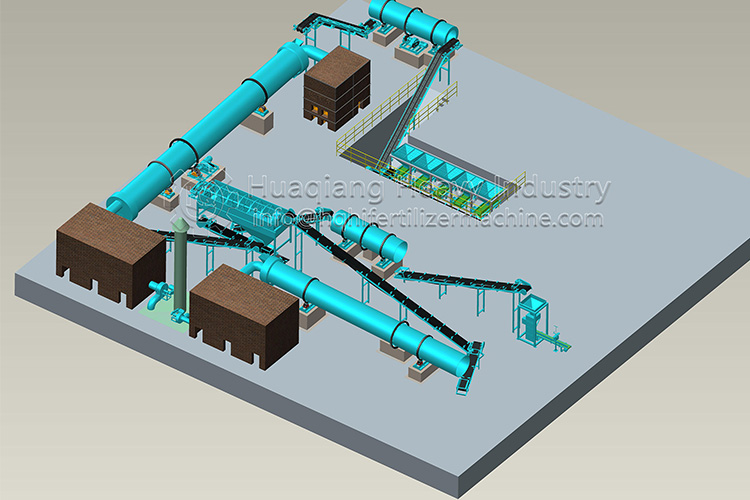
Yet, the higher costs of an NPK line are offset by higher added value: high nutrient concentration, stable pricing, and—once scaled up—a potentially faster return on investment. Organic fertilizer lines, meanwhile, benefit from low-cost raw materials, substantial government subsidies, and lower risk, making them well-suited for the localized processing and consumption of organic waste.
The key to choosing the right system is not whether it is "expensive," but whether it is "the right fit." If you have access to a stable supply of raw materials and a local market, an organic fertilizer line is a pragmatic choice. Conversely, if your goal is to target the broader, high-volume market for high-concentration compound fertilizers, the significant investment required for an NPK production line becomes a sound strategic decision.