
In the field of mineral fertilizer granulation, disc granulation technology holds an important position due to its wide applicability and simple process. Its core differences from mainstream methods such as double roller press granulator and spray granulation are significant.
The granulation principle and process complexity differ markedly. Disc granulation utilizes an inclined rotating disc, using friction and centrifugal force along with a small amount of water to cause the material to roll and agglomerate into shape. The process is simple and requires no complex pre-treatment. Roller extrusion granulation is a dry granulation method, where dry material is compressed into sheets by double rollers, then crushed and screened. It requires no water addition, but strict control of raw material moisture content is necessary. Spray granulation requires the material to be made into a slurry, which is then atomized at high temperature and rapidly cooled to form granules. This process is complex and energy-intensive.
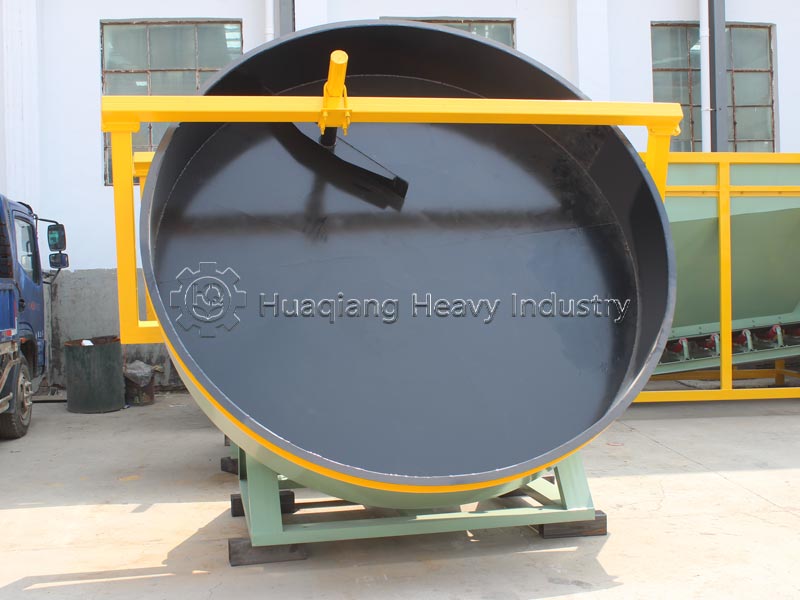
The suitability of raw materials and the characteristics of the finished products also differ. Disc granulation is suitable for various mineral raw materials such as ammonium phosphate and potassium chloride, with raw material moisture content controlled at 15%-25%. The finished product has high sphericity and uniform strength. Roller extrusion granulation is suitable for hard mineral raw materials with a moisture content of 8%-12%. The finished product is mostly columnar, with high strength but poor sphericity. Spray granulation is suitable for easily soluble mineral raw materials. The finished product consists of fine particles, which dissolve quickly but are prone to moisture absorption during storage.
Production capacity and energy consumption are suitable for different production scales. Disc granulators have low energy consumption and low investment costs, making them suitable for small and medium-scale production. Roller extrusion granulation has medium production capacity and moderate energy consumption, suitable for transitional scenarios between small and large-scale production. Spray granulation has a large production capacity but high energy consumption and high equipment investment, making it only suitable for large enterprises.