
When launching an NPK fertilizer project, the primary task is selecting the NPK fertilizer production technology. The chosen technical route dictates the layout, investment costs, and product positioning of the entire production line; errors in selection incur extremely high costs for subsequent adjustments.
Currently, there are three mainstream technical routes, each with specific application parameters. Drum granulation is a traditional wet process characterized by strong raw material adaptability and the ability to incorporate fillers to reduce costs; with a relatively low investment threshold, it is suitable for small-to-medium-sized projects (30,000–50,000 tons/year), though it entails higher energy consumption and yields granules with average visual quality.
Tower melt granulation involves spraying a mixture of molten urea, phosphate, and potash for cooling; this produces smooth, non-caking granules without the need for drying. However, it requires molten urea and ultra-fine grinding of phosphate and potash, entails significant investment, and is best suited for large-scale projects (over 100,000 tons/year).
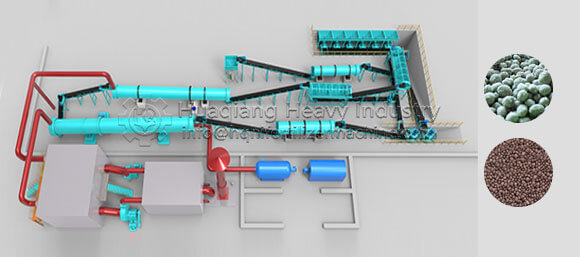
Extrusion granulation is a dry process featuring a short workflow and a small footprint, making it ideal for diverse, small-batch production; however, the resulting granules are irregular flakes, and market acceptance varies by region.
Once the technical route is determined, the configuration of the NPK compound fertilizer production line follows. Regardless of the process, the precision of the automatic batching and mixing stages is critical to quality: batching errors directly cause nutrient deviations, while mixing uniformity affects the consistency of fertilizer efficacy across individual granules. Furthermore, dust removal and material recycling systems are often underestimated; undersized fines must be automatically returned to the granulation section via enclosed conveyors for reuse—otherwise, dust accumulation can clog pipelines and reduce operational efficiency.
In summary, technical selection for NPK fertilizer projects should follow the principle of "raw materials determine the process, and scale determines the route": first assess raw material supplies, then select the process based on target capacity and product positioning, and finally refine the full-line configuration. Choosing the right technical route lays the foundation for the project's long-term, stable operation.