
Both disc granulators and double roller press granulators are commonly used in fertilizer processing. Both can granulate raw materials, but their granulation principles, characteristics, and suitable application scenarios differ significantly. Accurately distinguishing their features is crucial for matching processing needs and avoiding incorrect selection.
The granulation principles are drastically different: Disc granulators rely on the centrifugal force and friction of an inclined disc to roll the raw material into round granules, resulting in a gentle, pressure-free forming process. Double roller press granulators, on the other hand, use double rollers for high-pressure extrusion, eliminating the need for moisture and binders, making it a non-drying process.
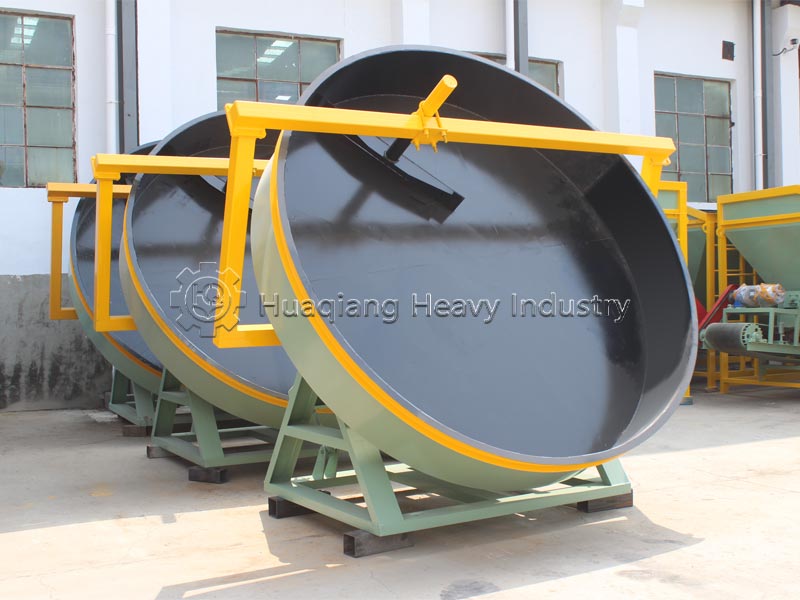
Their core characteristics differ: Disc granulators produce round, uniform granules with high strength, are easy to operate, have low energy consumption, and are easy to adjust, but have limited capacity, making them suitable for small to medium-scale operations. Double roller press granulators offer high efficiency, broad raw material adaptability, and can handle high-moisture, high-viscosity raw materials without drying, but their granule roundness is slightly inferior.
The suitable application scenarios differ significantly: disc granulators are suitable for small-to-medium-scale processing of organic and compound fertilizers, especially for scenarios requiring high-quality granules; double roller press granulators are suitable for large-scale production, adaptable to various raw materials, and prioritize high efficiency, low cost, and scenarios requiring no drying.
In summary, neither is inherently superior; the key difference lies in suitability: choose disc granulators for optimal granule appearance and small-to-medium production capacity; choose double roller press granulators for high efficiency, low cost, and large-scale production.