Investing in and constructing an NPK fertilizer plant involves process selection and the layout of the entire NPK compound fertilizer production line. However, some common misconceptions can lead to project setbacks. This article outlines three easily overlooked issues in the NPK fertilizer manufacturing process.
The first misconception is "the more advanced the equipment, the better." Some investors believe that higher levels of automation are always better, but advanced equipment means higher investment and maintenance costs. For small and medium-sized plants with an annual output of less than 30,000 tons, while high-tower granulation is advanced, its investment payback period is too long; while rotary drum granulation is traditional, its technology is mature, parts are interchangeable, and operators are easy to recruit, resulting in a higher overall cost-effectiveness. Process selection should match production capacity and product positioning, rather than blindly pursuing novelty.
The second misconception is "ignoring the limitations of raw materials on the process." Different processes have significantly different adaptability to raw materials. Rotary drum granulation is not sensitive to raw material particle size and can incorporate low-cost fillers to reduce costs. High-tower granulation, on the other hand, requires the nitrogen source to be molten urea or ammonium nitrate, and the phosphorus and potassium raw materials need to be ultra-finely ground, placing higher demands on raw material quality. If a stable supply of high-grade raw materials is lacking in the vicinity of the factory, forcibly choosing a high-tower process will only leave the plant vulnerable. The reliability of the raw material supply chain should be assessed during the design phase.
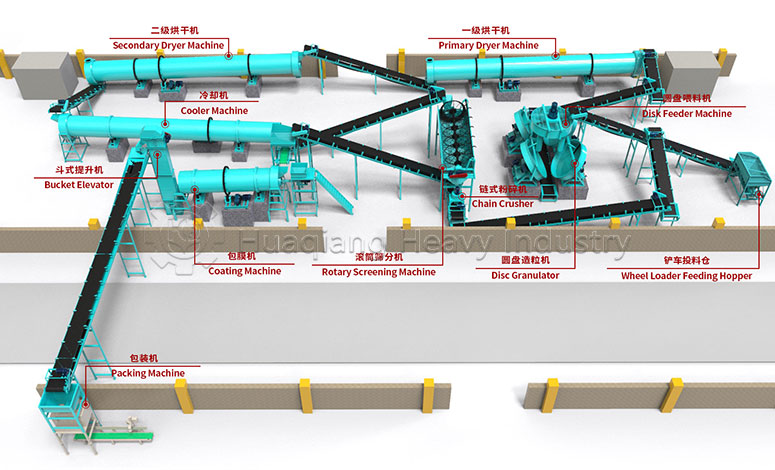
The third misconception is "emphasizing main equipment while neglecting auxiliary equipment." Many plans focus only on large equipment such as granulators and dryers, neglecting auxiliary facilities such as dust removal systems, return conveyor belts, and electrical control cabinets. As a result, even if the main equipment is good, excessive dust levels may lead to penalties, or a poorly designed return system may cause poor material circulation, significantly reducing the overall production capacity. The failure rate of auxiliary equipment is often higher than that of the main equipment, especially screening machines and conveyor belts, which require regular maintenance.
In summary, planning an NPK compound fertilizer production line should follow the logic of "raw materials determine the process, production capacity determines the scale." A successful NPK fertilizer plant hinges on systems thinking; nothing should be neglected, from raw material procurement to the completeness of supporting facilities. Avoiding these three misconceptions is half the battle won.