
Many established NPK fertilizer plants consider adding a BB (Bulk Blend) fertilizer production line to complement their product portfolio. The BB fertilizer production process differs significantly from that of NPK compound fertilizers; understanding these differences—and their impact on production costs—is essential for making sound investment decisions within the existing operational framework.
There are fundamental differences between the BB fertilizer production process and NPK compound fertilizer manufacturing. BB fertilizer production simply involves mixing pre-granulated base fertilizers according to a specific formula, requiring only a mixer as the core piece of equipment. Adding a BB line to an NPK plant involves relatively limited hardware investment—primarily the addition of an automatic batching system and a low-speed mixer—while allowing for the utilization of existing packaging equipment.
Cost pressures for BB fertilizer stem primarily from raw material loss and labor requirements. Since the process skips granulation and drying, any breakage of base fertilizer granules during mixing and transport translates directly into losses as fine powder; the raw material loss rate per ton is typically 0.5%–1% higher than in the NPK process. Furthermore, the variability of BB fertilizer formulas and smaller batch sizes necessitate frequent formula changes, which increases cleaning time and labor intensity.
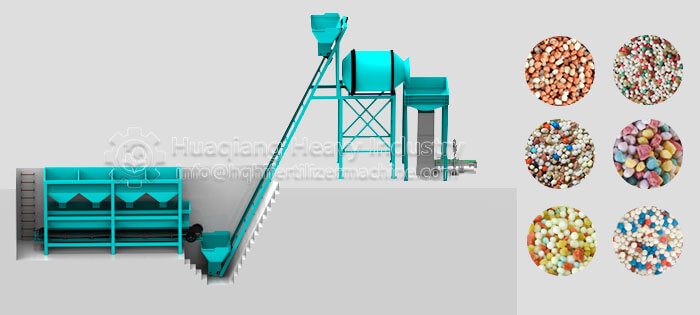
Space utilization must also be carefully planned when adding a BB fertilizer production line to an existing NPK plant. The raw material warehouse requires a dedicated area to store various base fertilizer granules, preventing cross-contamination with powdered NPK raw materials. Additionally, the mixing zone should be located near the packaging line to minimize transport distances and reduce the risk of material segregation.
From a plant-wide operational perspective, the BB line need not operate in isolation; it can create synergies with the existing system. For instance, fine powder screened out from the BB line can be fed into the NPK compound fertilizer recycle system for re-granulation, thereby achieving a closed-loop material utilization process.
In summary, while the BB fertilizer production process is straightforward, adding such a line requires a comprehensive evaluation of raw material losses, labor efficiency, and spatial layout in the context of BB fertilizer production costs.