
NPK fertilizer manufacturing involves the coordination of multiple processes. The value of a high-efficiency NPK fertilizer plant lies not merely in the performance of individual machines, but in the seamless coordination of all stages within the NPK compound fertilizer production line. The integration of these processes directly impacts both cost and product quality.
NPK production comprises five key stages—raw material processing, proportioning, granulation, drying and cooling, and screening and packaging—requiring balanced production capacities across all sections. Focusing solely on the granulator while neglecting upstream crushing capacity creates bottlenecks, causing the line's total output to fall far below design specifications. Consequently, capacity matching calculations for each stage are central to the planning process.
The design of the recycle system is equally critical. Off-specification granules separated during screening must be returned to the granulation stage for reprocessing; poor path design leading to blockages or insufficient conveying capacity causes frequent line stoppages and restarts, thereby increasing energy consumption. A sound design ensures the recycle system possesses adequate buffering capabilities.
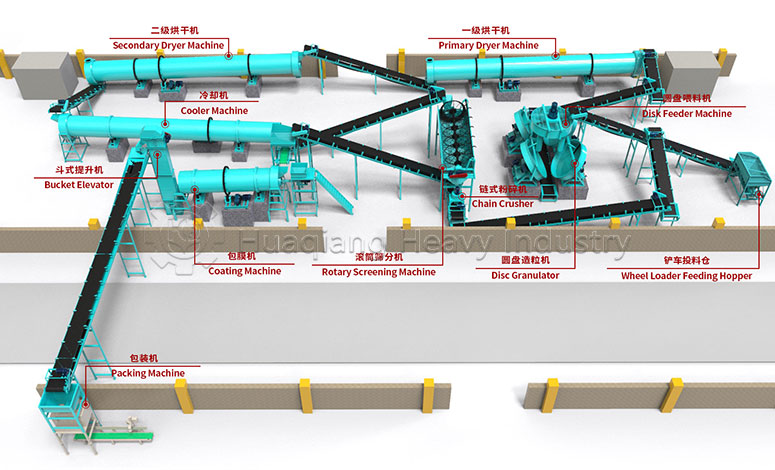
From an operational perspective, the layout of raw material storage, semi-finished product areas, and finished product zones significantly impacts efficiency. Locating raw materials close to the proportioning stage minimizes handling distances, while aligning finished product areas with packaging lines reduces the need for intermediate transport. Conversely, a fragmented layout increases labor costs and the risk of product damage.
The level of automation influences labor dependency and batch consistency. Although automatic proportioning and online monitoring systems entail higher initial investment, they reduce human error—a factor of particular importance for projects with an annual capacity exceeding 50,000 tons.
In summary, the successful manufacturing of npk fertilizer depends less on the sophistication of individual pieces of equipment than on the balance of the entire line, the design of the recycle system, and the rationality of the plant layout. Equipment selection must be predicated on line-wide compatibility, and plant planning must center on material flow; only through such a systematic approach can the facility achieve optimal performance.