
Cow dung has a high moisture content, coarse fibers, and a moderate carbon-to-nitrogen ratio. While its nutrient content may be lower than that of chicken or pig manure, its loose texture makes it excellent for soil improvement. A common mistake when setting up a production line is purchasing equipment before defining the final product; the logical approach is the reverse: determine the form of the finished product first, then work backward to design the process.
Step 1: Define the product form. Producing powdered organic fertilizer requires the shortest process—solid-liquid separation (or mixing with straw to adjust moisture) → aerobic fermentation → pulverization → screening → packaging. This approach involves lower investment, offers a faster return on investment, and is well-suited for local consumption. Producing granular fertilizer, by contrast, requires additional steps such as granulation, drying, and cooling. While this increases both capital expenditure and energy consumption, it enhances the product's commercial appeal and extends its viable transport radius. Given the high fiber content in cow dung, careful attention must be paid to the fineness of the material during pulverization; an excess of coarse fibers can negatively affect the granulation rate.
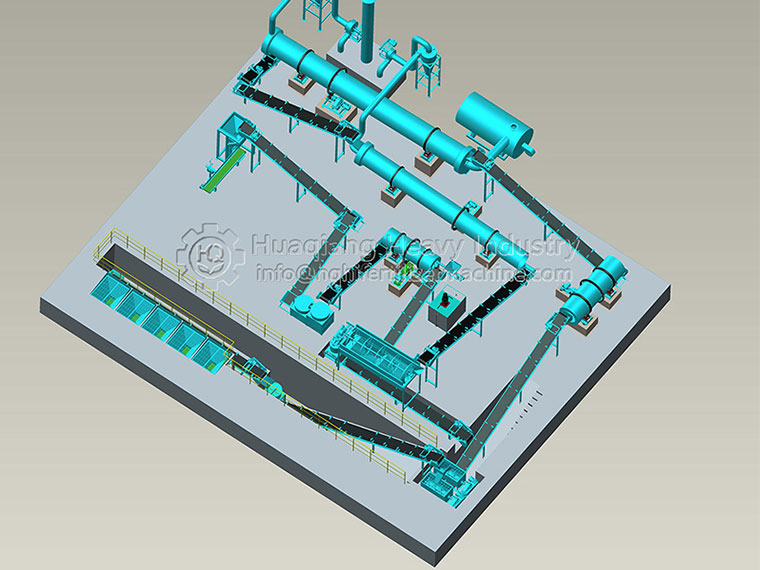
Step 2: Determine the fermentation method. Cow dung has decent permeability, making windrow fermentation—which requires low investment—a suitable choice for smaller-scale operations with ample space. Alternatively, in-vessel (trough-based) fermentation is more space-efficient and offers better control over temperature and oxygen levels; it is ideal for projects with an annual output exceeding 10,000 tons or those subject to strict environmental regulations. The keys to successful fermentation are uniform turning and effective temperature management; the capacity of the turning equipment must be matched to the dimensions of the fermentation troughs or windrows.
Step 3: Align the various process stages. The solid-liquid separator determines whether moisture content meets the required standards; the pulverizer’s output fineness influences the efficiency of granulation and screening; and the screening machine separates recycled material (fines/oversize) from the finished product. The hourly throughput capacity should increase slightly at each successive stage to ensure a stable material flow and prevent any single piece of equipment from becoming a bottleneck.
Finally, do not overlook site requirements and environmental compliance. Although the odor from cow dung fermentation is relatively mild, provisions for odor control and anti-seepage measures are still necessary. For granular fertilizer lines, one must also account for a heat source for drying and systems for dust management.
The logic behind setting up a cow dung organic fertilizer production line is to first clarify who the target customers are and what form the product will take, and then configure the equipment to suit that specific product.