
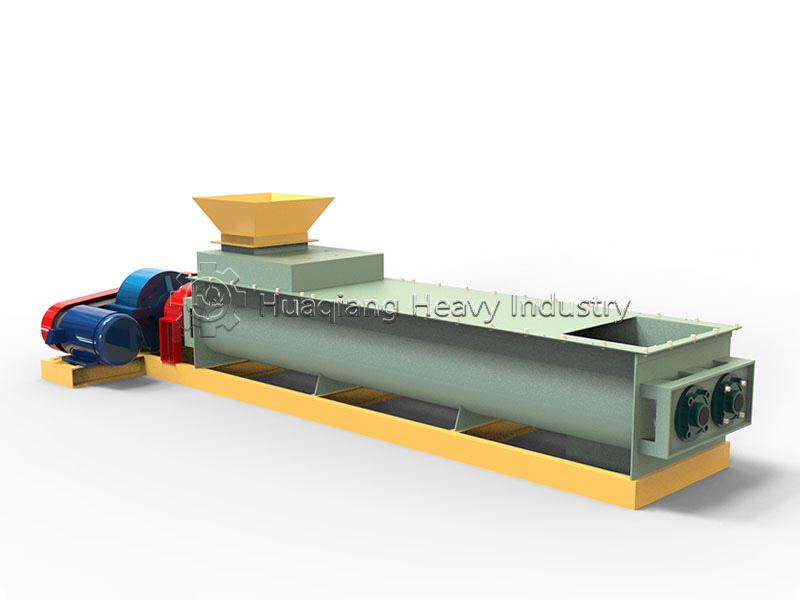
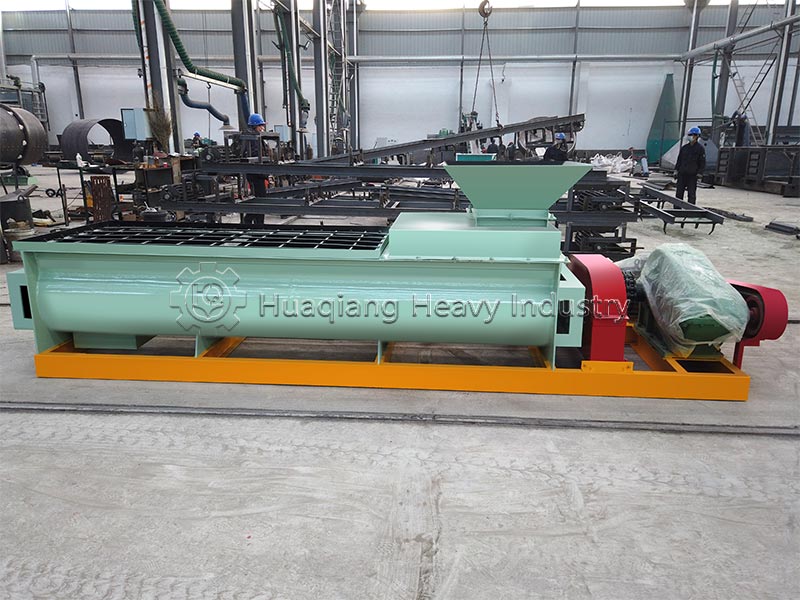
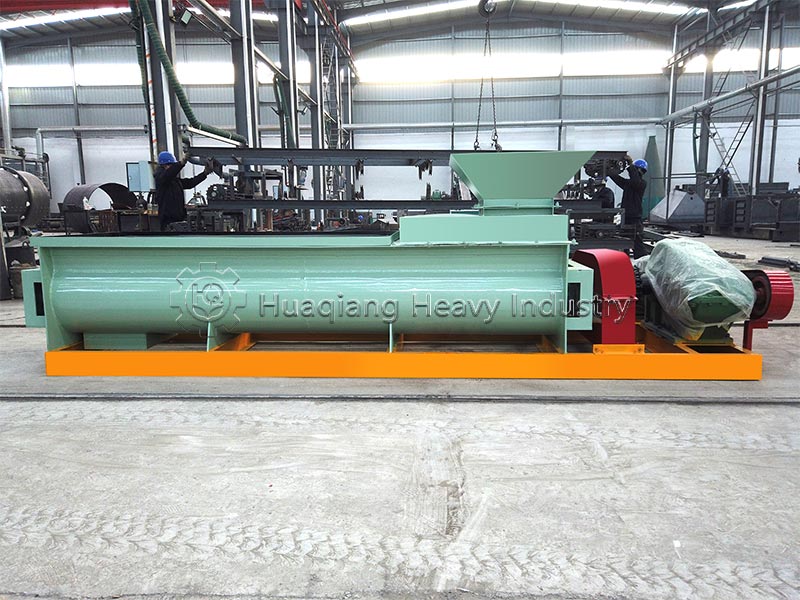
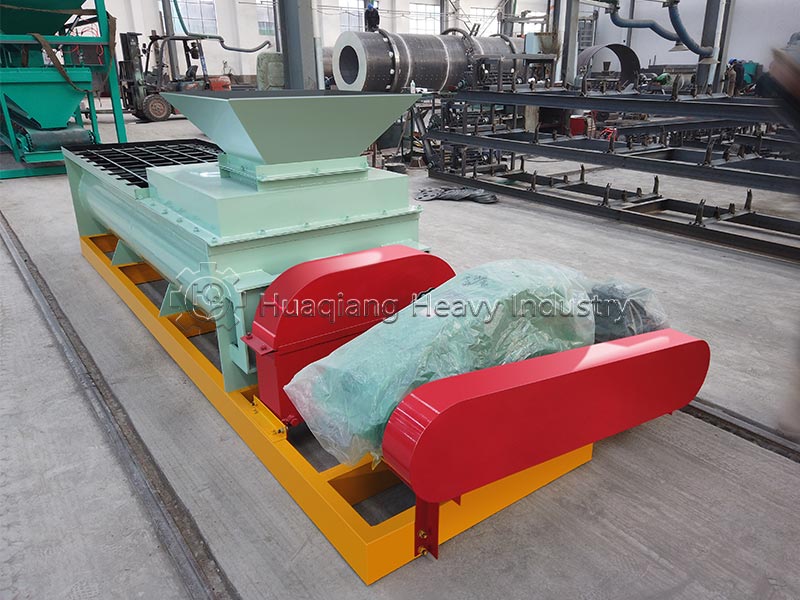
The double shaft paddle mixer is a core piece of equipment in the ingredient mixing stage of organic and compound fertilizer production lines, designed to rapidly and uniformly blend various raw materials according to specific formulas. It utilizes two horizontal shafts to drive paddles in counter-rotation, creating a highly efficient fluidized mixing zone between the shafts. This equipment is particularly well-suited for processing materials containing minor additives—such as trace elements or functional microbial agents—as it can evenly disperse these small-quantity components throughout the bulk base material; the resulting mixing uniformity directly ensures the quality of the finished fertilizer.
Working Principle
Upon entering the mixing trough, the two horizontal shafts rotate in opposite directions. As the paddles rotate, they propel the material both axially and radially, creating a superposition of multi-directional movements. Material situated between the two shafts undergoes repeated shearing and convective action, resulting in intense mixing. Simultaneously, the paddles continuously lift material from the trough bottom and walls to prevent sedimentation. As the material repeatedly passes through the dual-shaft interaction zone, the various components rapidly permeate and blend with one another.
Suitable Raw Materials
Organic fertilizer materials: Blending fermented organic fertilizer powder with auxiliary materials.
Compound fertilizer materials: Uniform mixing of various inorganic fertilizers and fillers.
Organic-inorganic mixtures: Blending organic materials with chemical fertilizers.
Trace element addition: Uniform dispersion of small amounts of trace nutrients into bulk base materials.
Bio-organic fertilizer materials: Mixing functional microbial agents with organic carriers.
Basic Material Requirements
Input material fineness should generally be below 2mm; excessively coarse particles can reduce mixing uniformity.
Regarding moisture content, it should be controlled below 15% for dry powder mixing and should not exceed 30% for semi-wet material mixing.
Materials must be free of large, hard objects that could jam the paddles or damage the mixing trough.
Liquid additives should not exceed 15% of the total weight and must be sprayed in evenly during the mixing process to prevent localized over-saturation and clumping.
| Model |
Reducer Model
|
Power(kw) | Speed(r/min) | Capacity(t/h) |
Weight(kg)
|
| 400 | 400-1V-2 | 11 | 52 | 20 | 2350 |
| 450 | 500-1V-2 | 15 | 52 | 25 | 2620 |
| 500 | 500-1V-2 | 18.5 | 53 | 30 | 2980 |
| 550 | 650-1V-2 | 22 | 53 | 35 | 3450 |
| 600 | 650-1V-2 | 30 | 52 | 40 | 3850 |
| 650 | 750-1V-2 | 37 | 52 | 45 | 4260 |