

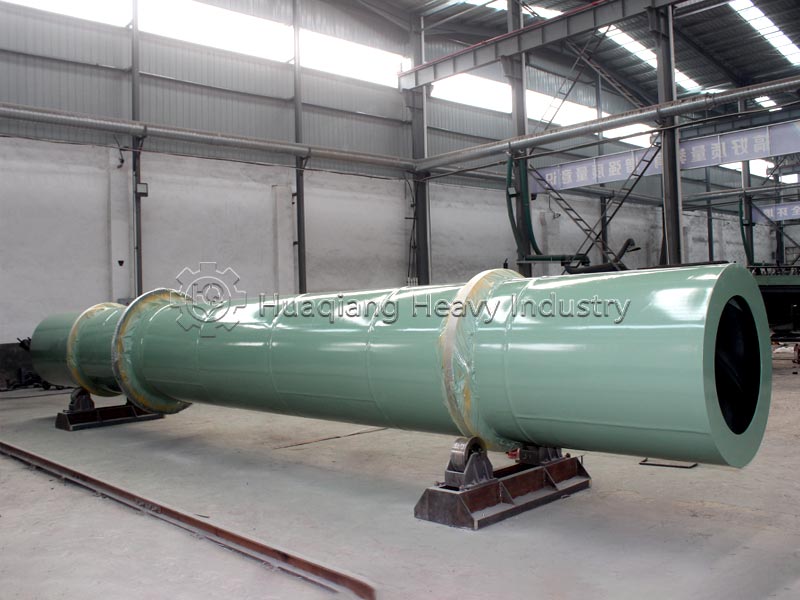
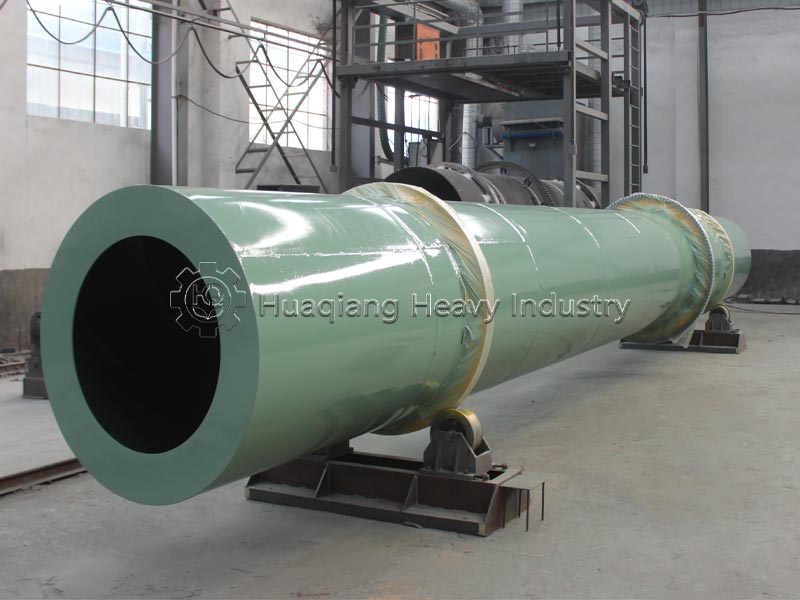
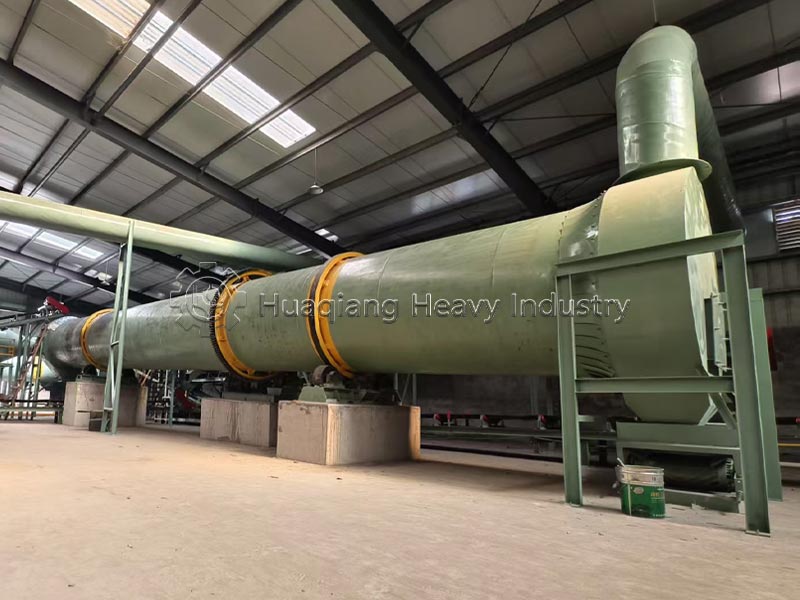
The drum fertilizer dryer serves as the core drying unit in granular fertilizer production lines—positioned after granulation and before cooling and screening—and is essential for transforming wet granules into qualified finished products. Wet granules exiting the granulator have high moisture content and low structural strength; drying is mandatory to meet storage and transportation standards. The equipment integrates seamlessly with upstream and downstream processes; drying performance directly impacts product quality, granule strength, and subsequent screening efficiency, making it a critical stage for ensuring the production line's overall capacity and product quality.
Drying Process
The granular fertilizer drying process utilizes continuous hot-air drying. Wet granules from the granulator are fed into the dryer's inlet via a belt conveyor, while high-temperature hot air—generated by a hot-blast stove—is introduced into the rotary drum through an inlet duct. Inside the drum, lifting flights repeatedly lift and shower the material, facilitating thorough heat exchange with the hot air; moisture evaporates continuously and is exhausted along with the waste gas. Dried material exits the drum and enters a cooler to lower its temperature before proceeding to screening and classification. Exhaust gas undergoes dust removal to ensure emissions meet regulatory standards. Drying temperature, drum rotation speed, and airflow volume are adjusted based on the specific material type and initial moisture content.
Process Advantages
Continuous operation ensures a seamless flow from inlet to outlet, making it ideal for large-scale production.
The drying process is controllable; finished product moisture levels can be precisely regulated by adjusting air temperature, airflow, and rotation speed.
Granules tumble and collide within the drum, smoothing their surfaces and enhancing the finished product's appearance.
Tight integration with upstream and downstream equipment minimizes material transfer steps, resulting in high overall production line efficiency.
Waste heat can be recovered and reused, improving the energy efficiency of the entire line.
Application Scenarios
Organic fertilizer production lines: Low-temperature drying of organic fertilizer granules to preserve organic matter and the activity of microbial agents.
Compound fertilizer production lines: High-temperature, rapid drying of high-concentration compound fertilizer granules.
Organic-inorganic compound fertilizer production: Drying of mixed-type fertilizer granules.
Bio-organic fertilizer production lines: Low-temperature, slow drying of granules containing functional bacteria.
Single-nutrient fertilizer production: Drying of finished products such as granular urea and granular potash fertilizer.
| Size | Shell | Capacity | Inlet temp of hot air | Outlet temp of hot air | Motor | Decelerator model | |||||
| Inner diam | length | inclination | Rotation speed | Model | Power | Rotation Speed | |||||
| mm | mm | 0 | r/min | t/h |
°C |
°C |
|
|
|||
| ZG12120 | 1200 | 12000 | 2-5 | 7.0 | 2-2.5 | 150-250 | 60-80 | Y160M-4 | 7.5 | 1460 | ZQ350 |
| ZG15120 | 1500 | 12000 | 2-5 | 6.0 | 4-6 | 150-250 | 60-80 | Y160L-4 | 15 | 1440 | ZQ400 |
| ZG15150 | 1500 | 15000 | 2-5 | 6.0 | 5-7 | 150-250 | 60-80 | Y160L-4 | 15 | 1440 | ZQ500 |
| ZG18150 | 1800 | 15000 | 2-5 | 5.0 | 7-10 | 150-250 | 60-80 | Y200L1-6 | 18.5 | 970 | ZQ500 |
| ZG20200 | 2000 | 20000 | 2-5 | 3.9 | 8-14 | 150-250 | 60-80 | Y200L2-6 | 22 | 970 | ZQ650 |
| ZG22220 | 2200 | 22000 | 2-5 | 3.2 | 12-16 | 150-250 | 60-80 | Y250M-6 | 37 | 980 | ZQ750 |
| ZG24240 | 2400 | 24000 | 2-5 | 3.0 | 14-19 | 150-250 | 60-80 | Y280S-6 | 45 | 970 | ZQ850 |