
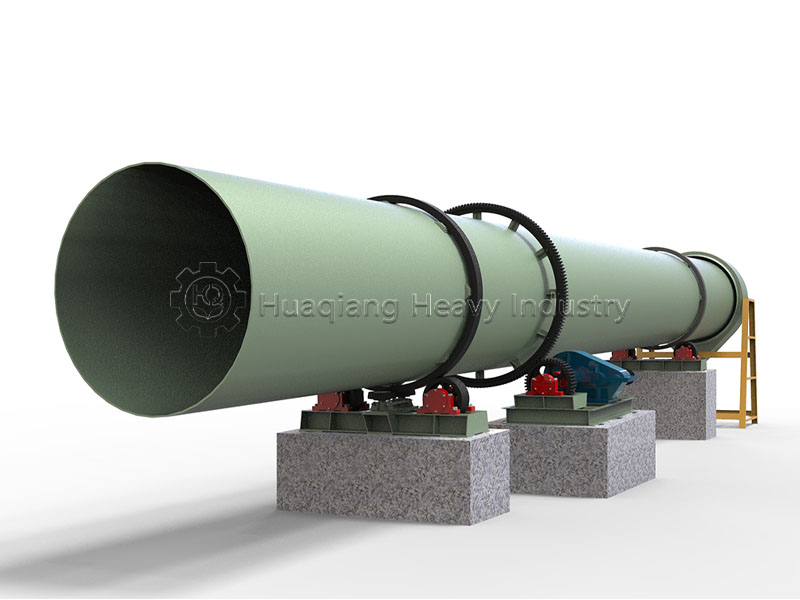
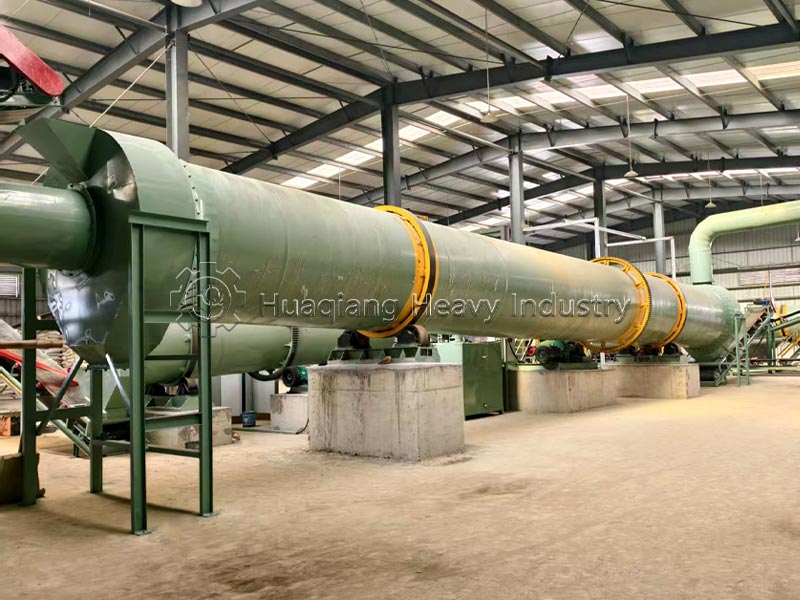
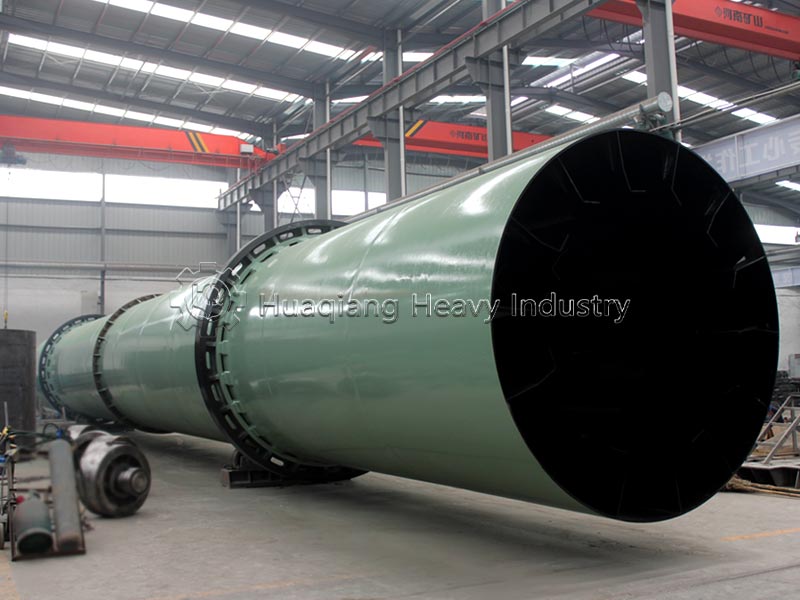
The drum fertilizer cooler is specialized equipment designed to rapidly cool high-temperature fertilizer granules—discharged from the drying stage—to near-ambient temperatures. It is a key component in organic and compound fertilizer production lines, positioned immediately after the drying section. Granules exiting the dryer typically range from 60°C to 90°C; direct packaging at these temperatures would cause caking, moisture re-absorption, and product deterioration. The cooler utilizes a rotating drum to ensure thorough contact between the material and either natural or forced cooling air, lowering the granule temperature to slightly above ambient levels and facilitating subsequent screening, coating, packaging, and storage.
Working Principle
Hot granular material enters the rotating drum at the feed end; the drum rotates at a constant speed and a specific inclination angle. Lifting flights (lifters) on the inner drum wall repeatedly lift and shower the material, creating a uniform curtain of granules. Ambient air is drawn in by a fan from the discharge end, flowing counter-currently against the material to exchange heat and carry away thermal energy. Alternatively, a co-current airflow method may be used, where cold air is blown in from the feed end to achieve rapid cooling. Cooled material is discharged from the outlet, while exhaust gases undergo dust removal before release. The material moves toward the discharge end while simultaneously cooling within the drum.
Equipment Components
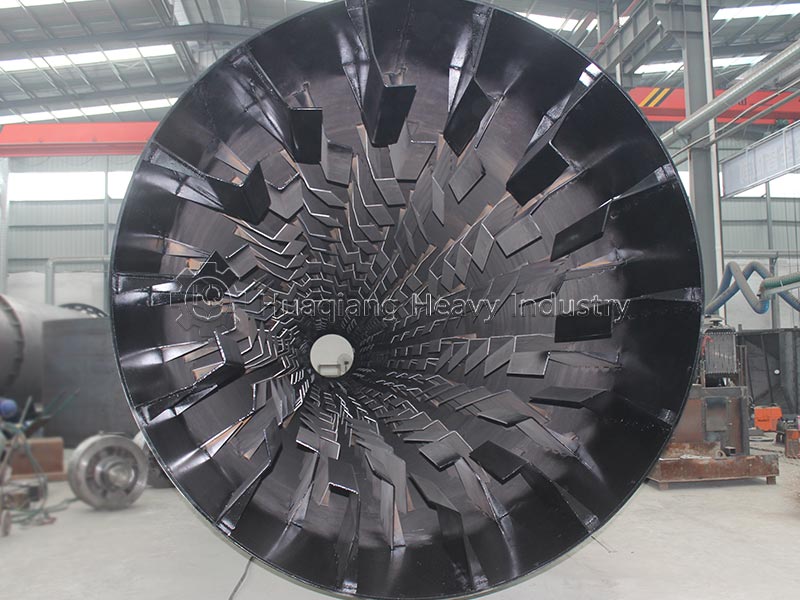
Rotating Drum: A cylindrical shell made of rolled and welded steel plate, installed at an incline and equipped with multiple layers of internal lifting flights.
Lifting Flights: Various types of flights welded to the inner wall to lift and scatter the material, creating a "curtain" of material.
Drive System: A motor drives a pinion gear via a speed reducer; the pinion meshes with a large girth gear to rotate the drum.
Support and Thrust Rollers: Four sets of support rollers bear the weight of the drum, while thrust rollers prevent axial shifting.
Air Intake and Exhaust Systems: Fans and ductwork to introduce cold air and discharge hot air.
Feed and Discharge Units: An inlet housing at the front connects to the dryer discharge, while an outlet housing at the rear handles both air exhaust and material discharge.
Performance Features
Excellent Cooling Effect: Material is thoroughly scattered and exposed to cold air; granule temperature can be reduced to within 5–10°C of ambient temperature.
High Processing Capacity: Drum specifications can be tailored to match the dryer's production capacity.
Stable Operation: Mature support roller design ensures smooth and reliable operation.
Anti-Caking and Moisture Resistance: Thorough cooling prevents caking and moisture re-absorption, ensuring good storage stability.
Low Energy Consumption: Relies primarily on natural air for cooling, resulting in minimal power usage.
| Model | Shell | Feed Temperature | Discharge Temperature | Motor | Decelerators model | |||||
| Inner diameter | length | Inclination | Rotation speed | Model | Power | Rotation speed | ||||
| mm | mm |
(0) |
r/min |
°C |
°C |
Kw | r/min | |||
| LQ10100 | 1000 | 10000 | 2-5 | 4.6 | 60-80 |
<40 |
Y132m-4 | 7.5 | 1440 | ZQ350 |
| LQ12120 | 1200 | 12000 | 2-5 | 4.6 | 60-80 |
<40 |
Y132m-4 | 7.5 | 1440 | ZQ350 |
| LQ15120 | 1500 | 12000 | 2-5 | 5 | 60-80 |
<40 |
Y160L-4 | 15 | 1440 | ZQ400 |
| LQ15150 | 1500 | 15000 | 2-5 | 5 | 60-80 |
<40 |
Y160L-4 | 15 | 1440 | ZQ500 |
| LQ18160 | 1800 | 16000 | 2-5 | 5 | 60-80 |
<40 |
Y200 L1-6 | 18.5 | 970 | ZQ500 |
| LQ20200 | 2000 | 20000 | 2-5 |
|
60-80 |
<40 |
Y200 L1-6 | 22 | 970 | ZQ650 |