
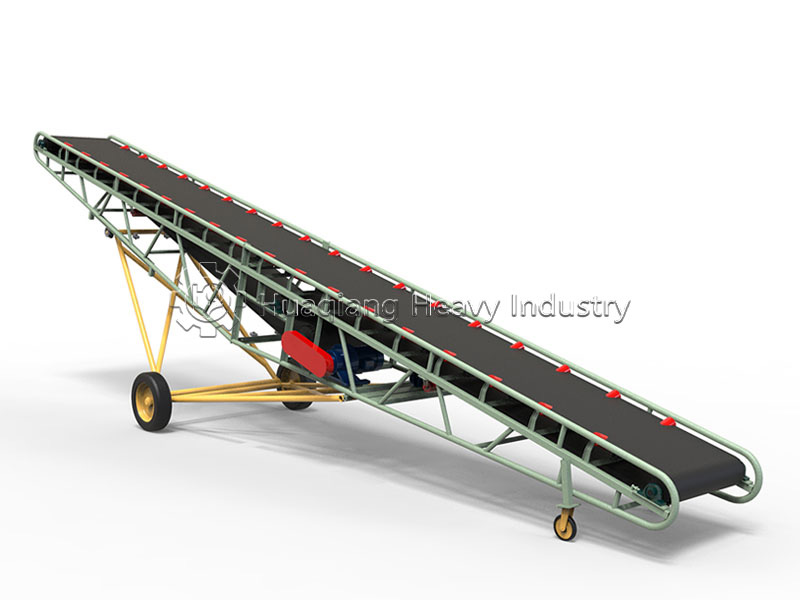
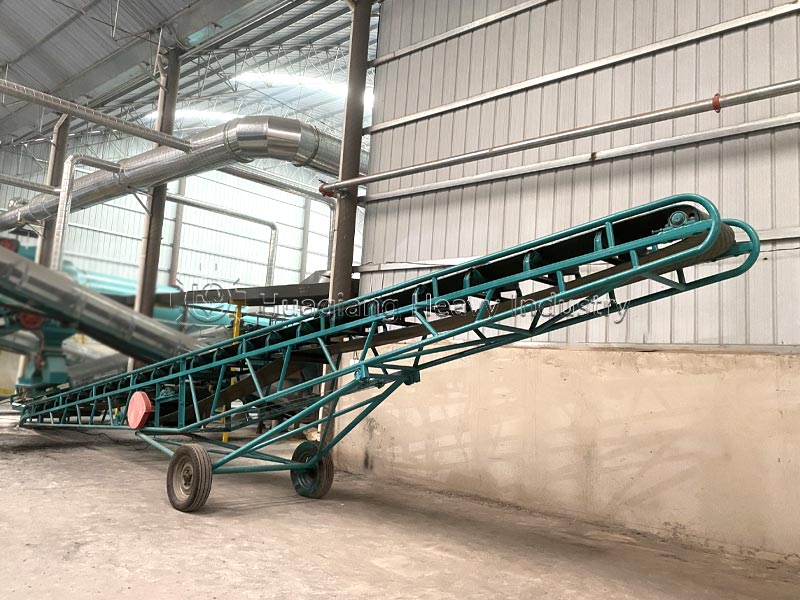
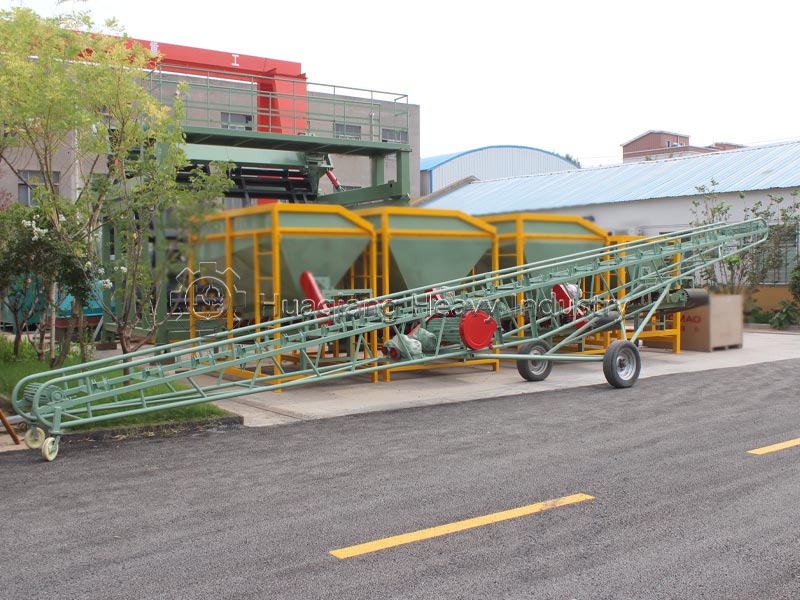
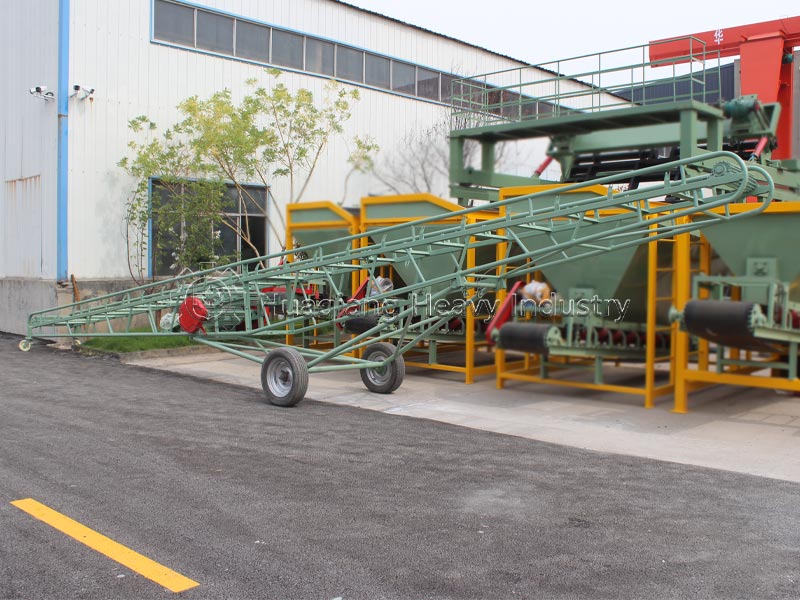
The mobile belt conveyor is a specialized piece of equipment used in the fertilizer industry for the flexible transfer, loading, and stacking of bulk materials. It features built-in wheels, allowing it to be moved as needed within workshops or warehouses without the need for a fixed foundation. The machine's tilt angle and conveying height are adjustable to accommodate loading or stacking needs at different heights. With its compact structure and high mobility, it is a common piece of equipment for loading finished products, transferring raw materials in stockpiles, and stacking packages in warehouses for organic and compound fertilizer companies. It can be easily pushed or pulled by one person, making it convenient to use and effectively improving material handling efficiency.
Working Principle
The motor drives the drum to rotate, which in turn drives the conveyor belt through friction. Material falls from the tail hopper onto the conveyor belt and moves forward with the belt to the head drum for discharge. The entire machine is mounted on a movable frame with wheels at the bottom, allowing it to be moved to the work site manually or by motorized towing. The lifting mechanism adjusts the head height via a screw or hydraulic device, changing the discharge point. Material runs smoothly on the conveyor belt without damage or spillage, achieving continuous conveying from low to high positions.
Equipment Composition
Conveyor Belt and Rollers: Rubber or PVC conveyor belts are used, with textured surfaces for anti-slip. The head roller is the drive roller, and the tail roller is the redirecting and tensioning roller.
Drive Unit: Motor and reducer directly drive the rollers; power is selected based on conveying length and lifting height.
Mobile Frame: Inclined or adjustable tilt frame welded from structural steel, with two sets of pneumatic tires or solid wheels installed at the bottom.
Lifting and Adjustment Mechanism: Manual screw lifting or hydraulic cylinder adjustment of the head height to adapt to different unloading heights.
Tail Feed Hopper: Located at the tail, with a guide chute for easy loading by forklift or manual labor.
Walking Wheels and Traction Frame: Steering wheels and traction rods are installed at the front or rear, allowing for manual pushing or pulling or motorized operation.
Electrical Control Box: Equipped with push-button start/stop control, can be conveniently located on the frame for easy operation.
Performance Features
Flexible Mobility: Equipped with wheels, can be pushed by one person, no foundation required, easy to relocate.
Adjustable Height: Lifting mechanism adjusts unloading height to adapt to different vehicle types and stacking height requirements.
Smooth Conveying: Materials move statically on the belt surface without damage or segregation, suitable for granular fertilizers.
High Adaptability: Can convey powder, granules, and small blocks; belt width and speed are selectable.
Simple Operation: Plug and play, works immediately upon connection to power; daily maintenance only requires lubrication and belt inspection.
| Length |
-6(-10)M |
-6(-10)M |
-6(-10)M |
-10(11-)M |
-10(11-)M |
-10(11-)M |
| Width |
500 |
650 |
800 |
500 |
650 |
800 |
| Height |
80 |
80 |
100 |
0 |
0 |
0 |
| Power |
2.2(3) |
3(4) |
5.5(7.5) |
3(4) |
3(4) |
5.5(7.5) |
| Rotation Speed |
72 |
72 |
55 |
55 |
55 |
55 |
| Transport volume |
7——10 |
10——18 |
15-20 |
10-19 |
13-25 |
20-45 |
| Angle |
20-60 |
20-60 |
20-60 |
0-23 |
0-23 |
0-23 |
| Transmission mode |
Direct connection of reducer |
Direct connection of reducer |
Direct connection of reducer |
Trigonometric belt |
Reducer chain |
Reducer chain |