
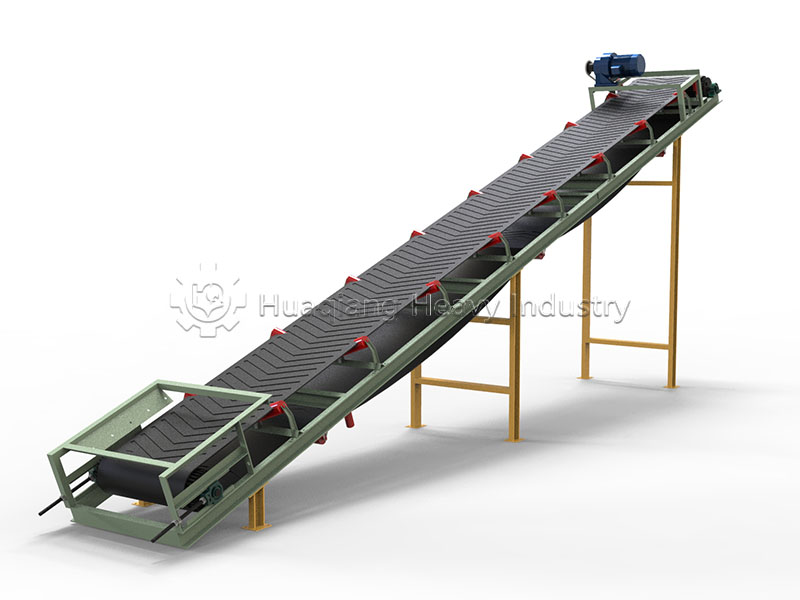
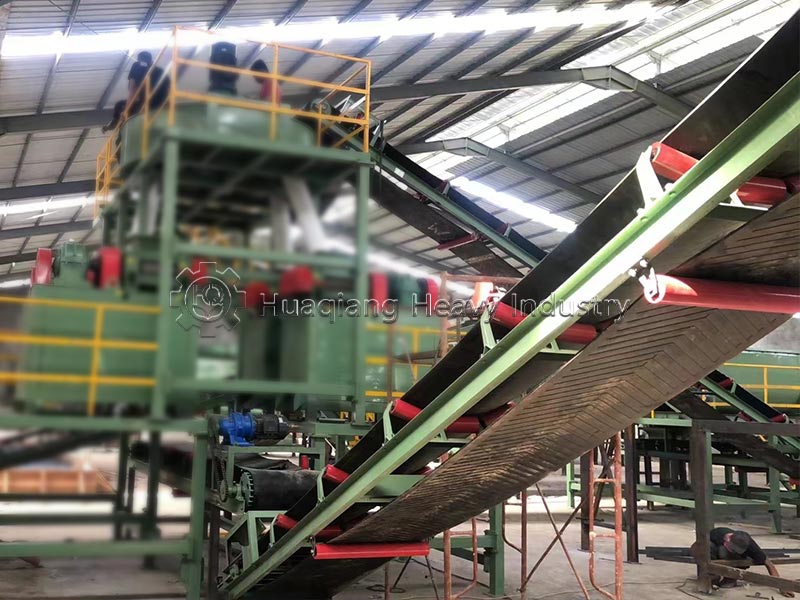
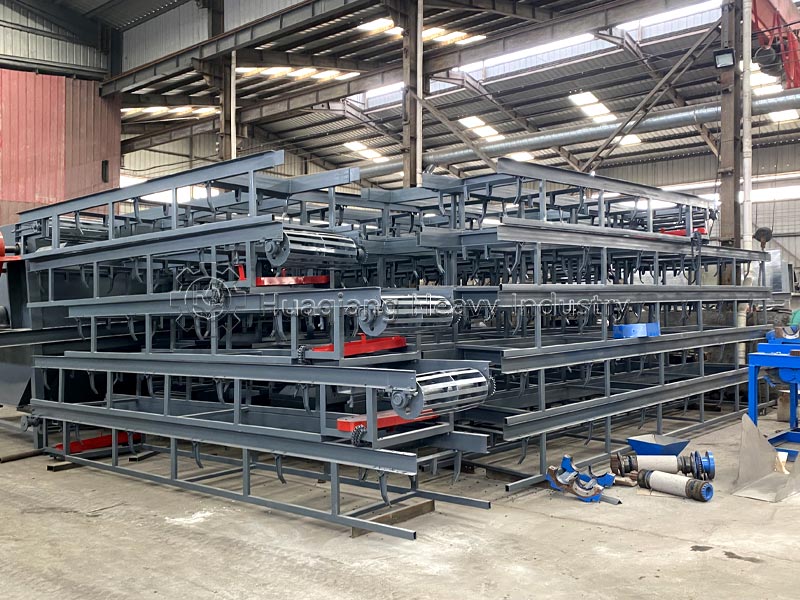

Belt conveyors are the most common material handling equipment in fertilizer plants, found almost everywhere from raw material stockpiles to finished product warehouses. Operation is extremely simple; once started, they provide continuous material flow to upstream and downstream equipment with stable operation, requiring minimal intervention. Daily inspections can be completed by one person, mainly checking the conveyor belt's running status and the idler rollers' flexibility. The equipment is highly automated and can be interlocked with the entire line's PLC, enabling one-button start/stop and fault alarms. For fertilizer production lines requiring long-term, stable transport of large tonnage materials, belt conveyors are fundamental and reliable transfer equipment.
Working Principle
The conveyor belt loops around the head and tail rollers and is tensioned by a tensioning device. The motor drives the head roller to rotate, relying on friction to circulate the conveyor belt. Material is received at the tail end and moves smoothly through the troughs formed by the troughing idlers, preventing spillage. Upon reaching the head roller, the material is overturned and discharged. The empty belt returns to the tail end via the return idlers to receive material again. The entire conveyor line can include multiple belt sections, with material relay transport achieved through transfer points.
Operating Procedures
Before starting the machine, the operator should check the conveyor belt and joints for integrity, ensuring all idlers are present and the rollers are free of foreign matter. Turn on the power, press the start button, and run the machine unloaded for several minutes, observing for belt misalignment and abnormal noises.
Once normal operation is achieved, notify the preceding process to begin feeding. The feeding rate is controlled by the feeder or gate, gradually increasing to the rated value. During operation, periodically check the temperature of the belt surface, idlers, rollers, and motor reducer.
Upon receiving a stop command, first stop feeding. After all material on the belt surface has been unloaded, press the stop button to stop the machine. In case of severe belt misalignment, slippage, or tearing, immediately pull the pull rope switches along the line for an emergency stop. During shift handover, clean any accumulated material under the head roller and any adhering debris from the belt surface.
Scope of Application
Organic Fertilizer Production Line: Horizontal or gently sloping conveying of fermented materials, crushed materials, mixed materials, and finished granules between workshops.
Compound Fertilizer Production Line: Material flow from raw material batching to granulation, drying, cooling, screening, and packaging.
Bio-organic Fertilizer Production: Low-intensity conveying reduces loss of microbial activity; suitable for gentle transfer of raw materials and finished products.
Feed and Grain Processing: Horizontal conveying of grains, oilseed cakes, and compound feeds within the plant.
Building Materials and Chemicals: Conveying powdered materials such as limestone, coal powder, and cement within the plant area.
| Belt Width (mm) |
Conveying length(m) Power(kw) |
Conveying speed (m/s) |
Delivery quantity (t/h) |
||
| 500 |
≤12 |
12-20 4-5.5 |
20-30 5.5-7.5 |
1.3-1.6 | 78-191 |
| 650 |
≤12 |
12-20
5.5 |
20-30 |
1.3-1.6 |
131-323 |
| 800 |
≤6 |
6-15 |
15-30
7.5-15 |
1.3-1.6 |
278-546
|
| 1000 |
≤10 |
10-20
7.5-11 |
20-40 11-22 |
1.3-2.0
|
435-853 |
| 1200 |
≤12 |
10-20 |
20-30 15-30 |
1.3-2.0
|
655-1284 |