

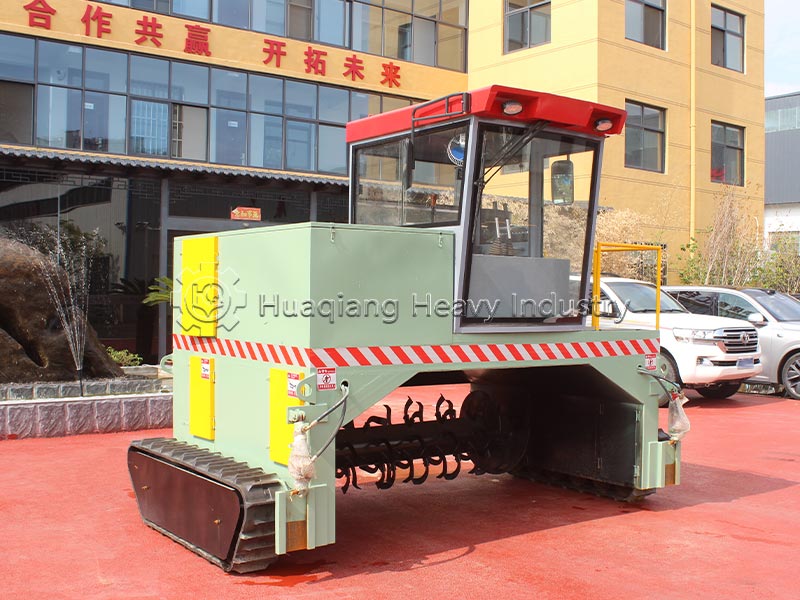
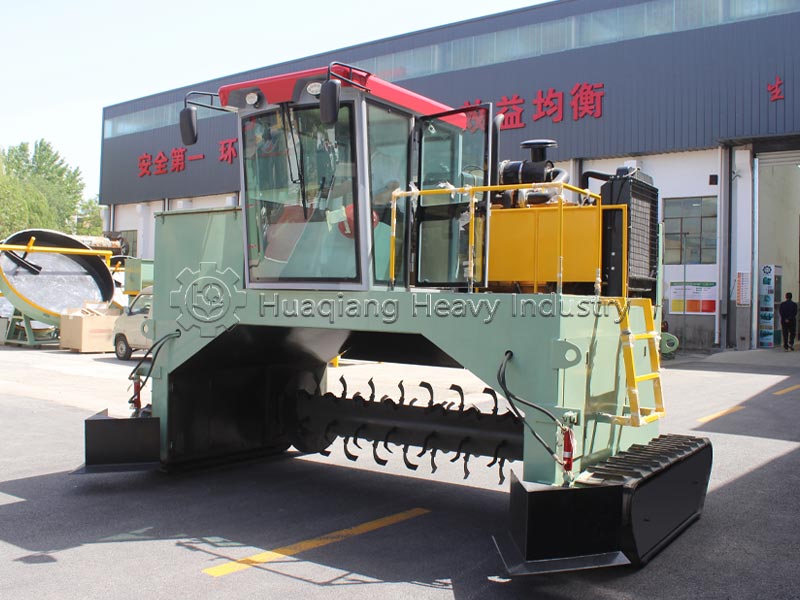
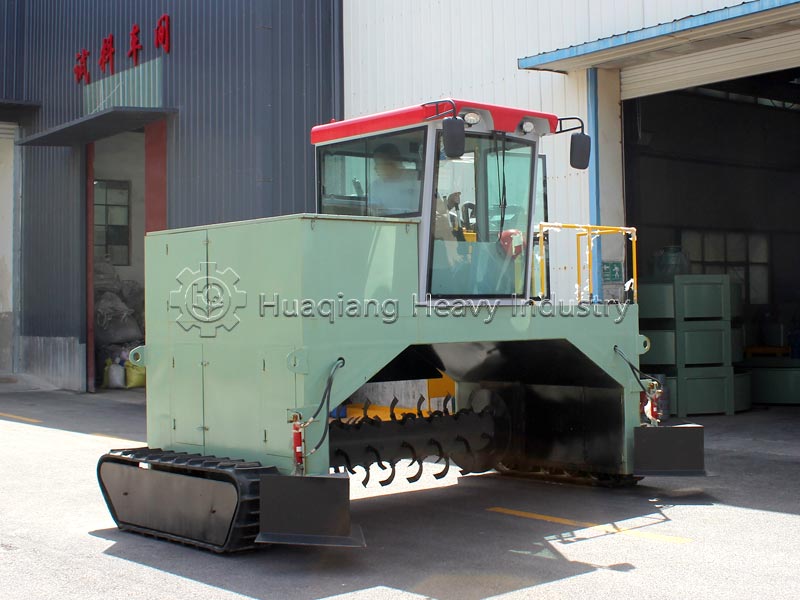
The windrow compost turning machine is a self-propelled fermentation and turning machine equipped with a crawler travel system and an integrated turning drum; it is primarily used for turning windrows during aerobic composting. Unlike wheel-type turners, this machine features a horizontally mounted rotating drum densely fitted with turning tines. The machine straddles the windrow and moves forward via a crawler chassis, turning and aerating the material as it travels. The crawler system offers low ground pressure and excellent mobility, ensuring stable operation on soft ground or sites that are wet following rain. Powered by an onboard diesel engine, it requires no external power supply, making it flexible and convenient for field operations. With a wide turning swath and high processing efficiency, this machine is suitable for windrow composting at medium-to-large livestock farms and organic fertilizer processing plants, making it one of the most widely used types of self-propelled turning equipment.
Working Principle of the Windrow Compost Turning Machine
The crawler-type compost turner employs a straddle-type design, with the machine spanning the windrow and the crawler system driving the frame slowly forward along the length of the pile. A turning drum is mounted horizontally beneath the frame and driven at high speed by the diesel engine via a transmission system. Turning tines, arranged in a dense spiral pattern around the drum, cut into the material layer from the bottom of the windrow; they scoop up the material, carry it upward with the drum's rotation, and cast it backward under the influence of centrifugal force. The material disperses in the air, makes full contact with the oxygen, and falls back onto the windrow, landing slightly behind its original position. As the machine advances, the drum continuously cuts into new sections of the pile, completing the turning and displacement of the entire windrow.
Equipment Components
Crawler Travel Chassis: Composed of two rubber or steel tracks, drive sprockets, track rollers, and travel motors. The large ground contact area and superior mobility prevent slipping or sinking on soft, muddy composting sites, ensuring stable movement.
Main Frame: Features a welded structural steel bridge-style frame that straddles the windrow, supporting all components such as the diesel engine, turning drum, and operator's platform. The frame's ground clearance is designed based on the maximum material pile height, ensuring sufficient space beneath the machine as it straddles the pile.
Power System: Equipped with a diesel engine as an independent power source; it requires no external cables, offering flexibility and convenience for field operations. The engine drives both the turning drum and the hydraulic crawler drive system, providing ample power reserves.
Turning Drum Assembly: A horizontally mounted rotating drum serves as the core turning component. Dozens of wear-resistant turning teeth are arranged on the drum surface in a double or triple-helix pattern. The drum is driven by a hydraulic motor or mechanical transmission, with adjustable rotational speed. The turning teeth are detachable and replaceable.
Lifting Mechanism: Hydraulic cylinders drive the vertical movement of the entire turning drum assembly to adjust the turning depth. The drum can be raised to a high position during relocation or shutdown, facilitating movement over piles or transfer between work sites.
What are the characteristics of crawler-type compost turners during the fermentation process?
Excellent Mobility and Terrain Adaptability: The crawler drive system exerts low ground pressure, allowing for stable travel and operation on muddy, soft, or uneven composting sites after rain, without being restricted by site paving conditions.
Wide Turning Width and High Efficiency: The horizontally mounted drum straddles the windrow, offering a turning width of over three meters. It turns the entire windrow in a single pass, resulting in higher efficiency compared to wheel-type turners that process material layer-by-layer; this makes it ideal for large-scale composting projects.
Deep Turning and Uniform Mixing: The drum's turning teeth cut in from the base of the pile, lifting and scattering material from bottom to top. This ensures thorough material exchange across layers, uniform temperature and moisture distribution, and consistent fermentation quality.
Adjustable Travel Speed for Various Conditions: The hydraulically driven crawler speed is continuously adjustable. Fresh material can be turned slowly and meticulously, while decomposed material can be processed quickly to boost efficiency, allowing a single machine to meet operational needs across different fermentation stages.
Improved Operating Environment: Certain models feature remote control capabilities, allowing operators to stay away from work sites characterized by high temperatures, high humidity, and heavy dust, thereby reducing labor intensity and occupational health risks.
What raw materials can the windrow compost turning machine process?
Livestock and poultry manure: Manure and waste from various livestock operations, such as chicken, pig, sheep, cattle, and duck manure. The windrow compost turning machine’s high power and strong turning capacity make it suitable for handling large volumes of high-moisture manure, enabling rapid and uniform mixing with bulking agents.
Crop stalks: Materials such as corn, rice, and wheat stalks are shredded and mixed with manure for composting; the tearing action of the drum’s turning teeth further breaks down fibrous material, accelerating decomposition.
Fungal residue and edible mushroom waste: Spent mushroom substrates and waste bags from mushroom production are de-bagged, broken up, and formed into windrows for fermentation; the crawler-type compost turning machine facilitates turning and oxygen supply, transforming the waste into raw material for organic fertilizer.
Landscaping waste: Shredded branches, fallen leaves, grass clippings, etc. Windrow composting handles large volumes, and the windrow compost turning machine offers distinct efficiency advantages due to its wide turning swath.
Industrial organic waste: Materials such as sugar mill filter mud, distillers' grains, cassava residue, and traditional Chinese medicine dregs. These vary in moisture content and viscosity, but the crawler-type turner’s high power and adjustable speed allow it to meet the turning requirements for materials with diverse physical properties.
Biogas residue and sludge: Biogas residue from biogas plants and dewatered sludge from municipal wastewater treatment plants are mixed with bulking agents (like stalks) and formed into windrows, undergoing harmless treatment through high-temperature aerobic fermentation.
| Model | HQ-FD 2500 | HQ-FD 2600 | HQ-FD 3000 |
| Width(mm) | 2500 | 2600 | 3000 |
| Height(m) | 500-1000 | 500-1100 | 500-1200 |
| Stack spacing (m) | 1.0-1.2 | 1.0-1.2 | 1.0-1.2 |
| Max Particle Size (mm) | 250 | 250 | 250 |
| Power | R4102 Turbocharged 90HP Diesel Engine |
R4105 Turbocharged 105HP Diesel Engine |
R6105 Turbocharged 136HP Diesel Engine |
| Rated power speed(r/min) | 2200 | 2200 | 2200 |
| Working speed(m/min) | 6-18 | 6-18 | 6-18 |
| Driving speed(m/min) | 50 | 50 | 50 |
| Processing capacity(m3/h) | 400-600 | 600-800 | 1000-1200 |
| Overall size(m) | 3.64×2.6×2.7 | 3.75×2.6×2.7 | 4.36×2.75×2.95 |