
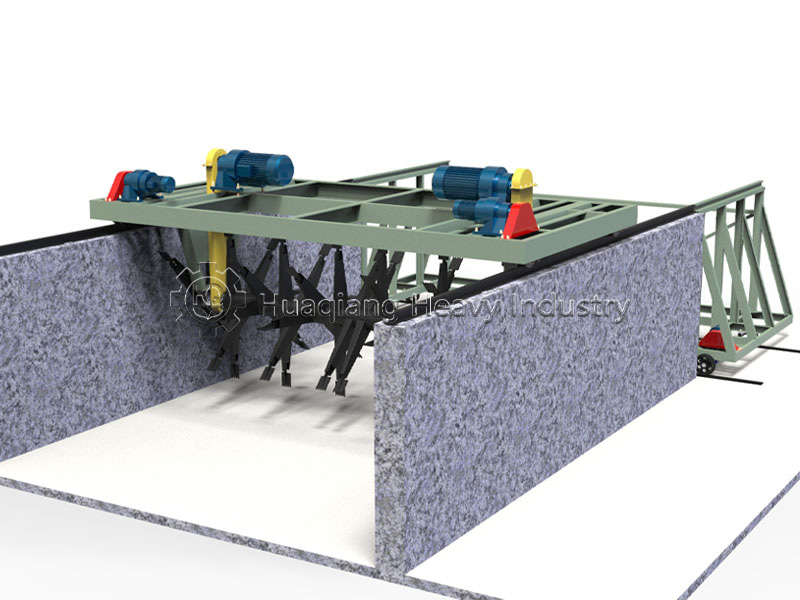
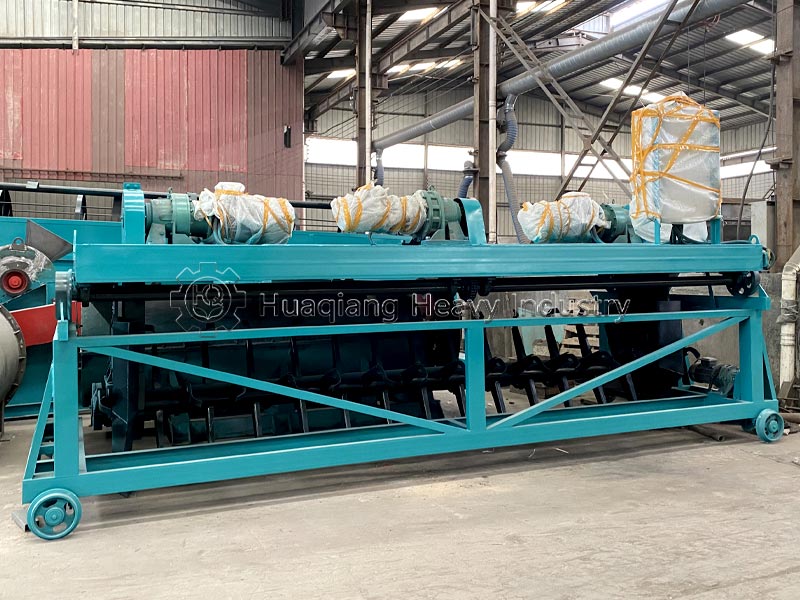
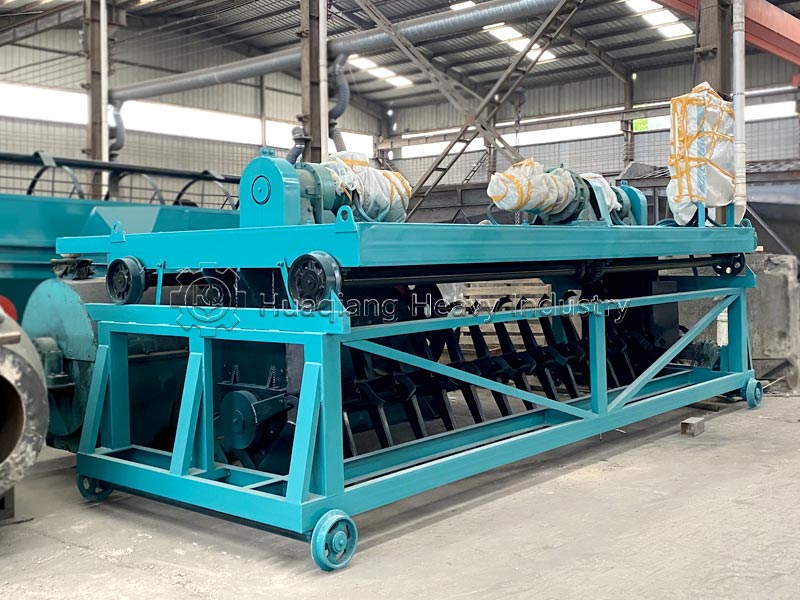

The simple trough compost turning machine is specialized equipment designed for the aerobic fermentation of organic fertilizer in channels. Its primary function is to turn, throw, and shift the material piled within the fermentation channel, thereby regulating temperature, moisture content, and oxygen levels to accelerate the decomposition of organic matter. The machine travels back and forth along rails mounted above the fermentation channel; it utilizes a rotating drum equipped with tines to break up and throw the material backward, simultaneously performing both turning and displacement operations. Compared to mobile windrow turners, simple trough compost turning machines offer a fixed fermentation space, allow for greater material stacking heights, and minimize heat loss, making them particularly suitable for the centralized composting of manure from small-to-medium-sized livestock farms and agricultural waste. Featuring a simple structure, ease of operation, and low running costs, this machine is a highly cost-effective fermentation solution for organic fertilizer production.
Working Principle of the Simple Trough Compost Turning Machine
The simple trough compost turning machine employs a rotating drum with tines to turn, throw, and shift the material. Spanning the fermentation trough, the machine is mounted on rails running along both sides, with a travel motor driving the entire unit forward at a constant speed. The main turning shaft extends across the channel, featuring multiple sets of tines arranged in a helical pattern. Driven by a motor, the shaft rotates at high speed; the tines penetrate the material from the bottom of the trough, scooping it up and throwing it backward and upward. As the material disperses in the air and falls back into the trough, the entire machine shifts backward by a certain distance. During this process, the material is thoroughly broken up and mixed with air, redistributing the material within the trough and ensuring more uniform temperature and moisture levels. As the machine traverses the length of the trough once or twice daily, the material gradually moves from the feed end to the discharge end, completing the turning and displacement tasks required for the entire fermentation cycle.
Equipment Components of the Simple Trough Compost Turning Machine
Travel Frame: A bridge-like frame welded from structural steel sections. Travel wheels are mounted at both ends, supporting the frame on rails installed along the sides of the fermentation channel. The frame supports all components, including the main turning shaft, the drive system, and the control console.
Turning Main Shaft and Toothed Roller: A rotating main shaft spans the width of the fermentation channel, fitted with dozens of turning teeth arranged in a double or triple helix pattern. These teeth are made of wear-resistant steel and are detachable for replacement; their shape and layout are designed based on material characteristics to balance the efficiency of breaking up clumps and throwing the material.
Travel Drive System: A travel motor drives the wheels along the track via a gearbox. The travel speed is adjustable, allowing control over the thoroughness of material processing and the distance moved during each pass.
Turning Drive System: A turning motor connects to the main shaft via belts or chains, driving the toothed roller to rotate at high speed. Power output is configured according to the channel width and material pile height, ensuring the teeth have sufficient force to cut into high-density material.
Lifting Mechanism: Some models feature a height adjustment device for the turning shaft, allowing the turning depth to be adjusted at different fermentation stages to accommodate changes in material height.
Electrical Control System: The control cabinet integrates functions such as travel speed regulation, turning start/stop controls, and limit protection. It can be configured with automatic reciprocating and timed operation programs to enable unattended operation.
What are the characteristics of simple trough compost turning machines during the processing of fermentation raw materials?
Uniform and Thorough Turning: The turning teeth cut into the material layer by layer from the bottom of the channel, lifting the material and throwing it backward. This ensures full mixing of the material—top-to-bottom and inside-out—preventing "dead zones" in fermentation and localized anaerobic conditions that cause odors.
Flexible Moisture Regulation: During the turning process, the material comes into full contact with the air, accelerating the evaporation of excess moisture. For high-moisture manure materials, increasing the turning frequency can rapidly reduce moisture levels to the optimal range for fermentation without the need to add dry materials.
Rapid Temperature Rise and Short Fermentation Cycle: Regular turning ensures an ample oxygen supply within the channel, keeping aerobic microorganisms active. Fermentation temperatures quickly rise to 50–70°C and are maintained for extended periods, effectively killing pathogens and weed seeds; the fermentation cycle is more than 50% shorter than that of natural composting.
Convenient Operation and Low Labor Requirements: A single operator can control the entire machine to complete daily turning tasks. With the automatic reciprocating function enabled, the equipment can operate unattended on a schedule, resulting in low labor costs.
Low energy consumption and cost-effective operation: The equipment has low total power requirements and low electricity consumption per unit of material turned; the only wearing parts requiring periodic replacement are the turning tines, resulting in minimal maintenance costs.
Clean workshop environment: Fermentation takes place in fixed tanks, and materials do not scatter during the turning process; combined with a tank-bottom aeration system, this prevents odor accumulation and ensures a pleasant working environment.
What raw materials can be processed by the simple trough compost turning machine?
Livestock and poultry manure: Manure from chickens, pigs, sheep, cattle, ducks, geese, and other livestock—this constitutes the bulk of material processed via tank-style turning fermentation. If the moisture content is high, the manure can be mixed with dry materials (such as straw powder) to adjust the moisture level before being loaded into the tank.
Agricultural waste: Materials such as straw powder, rice husk powder, corn cob powder, peanut shell powder, sugarcane bagasse, and spent mushroom substrate. These can serve as bulking agents mixed with manure for co-composting or be composted separately to produce organic fertilizer raw materials.
Landscaping waste: Shredded branches, fallen leaves, grass clippings, etc. These can be processed via tank-style turning fermentation into landscaping compost or soil amendments.
Kitchen and household waste: Sorted and shredded organic household waste—such as kitchen scraps and vegetable trimmings—can be rendered harmless and converted into resources through high-temperature aerobic fermentation in the tank.
Oilseed cakes and herbal medicine residues: By-products of oil processing (e.g., soybean meal, rapeseed meal) and spent residues from traditional Chinese medicine extraction can be converted into high-quality organic fertilizer through fermentation.
Other organic waste: Industrial organic waste such as sugar mill filter mud, distillery grains, vinegar residue, and biogas digestate can all be processed via tank-style turning fermentation into commercial organic fertilizers or soil conditioners.
| Model | Main Motor | Walking Motor | Lifting Motor | Mobile Car Motor |
| FD3 | 7.5kw*2 | 1.5kw | / | 1.5Kw |
| FD4 | 11kw*2 | 1.5kw | / | 1.5Kw |
| FD5 | 15kw*2 | 2.2kw | 0.75kw | 1.5Kw |
| FDT3 | 7.5 kw*2 | 1.5kw | 0.75 kw | 1.5Kw |
| FDT4 | 11kw*2 | 1.5 kw | 0.75 kw | 1.5Kw |
| FDT5 | 15kw*2 | 2.2 kw | 0.75 kw | 1.5Kw |