
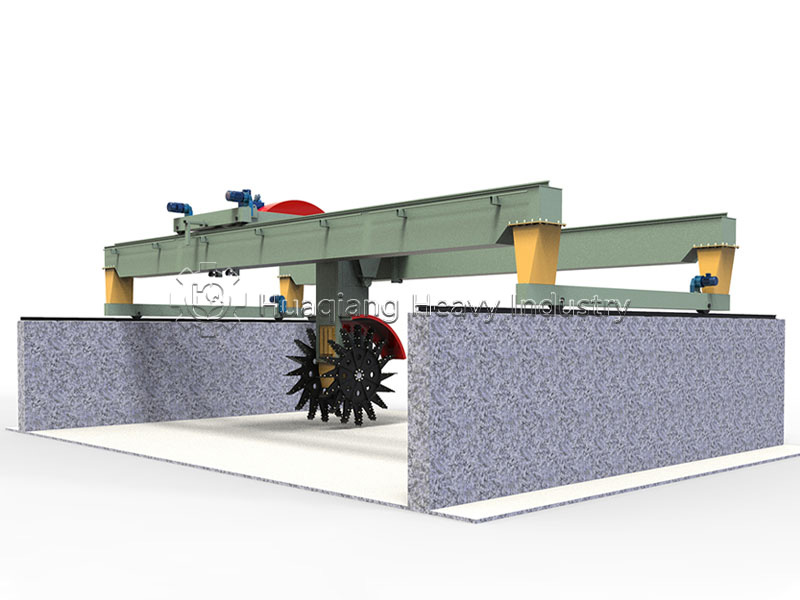
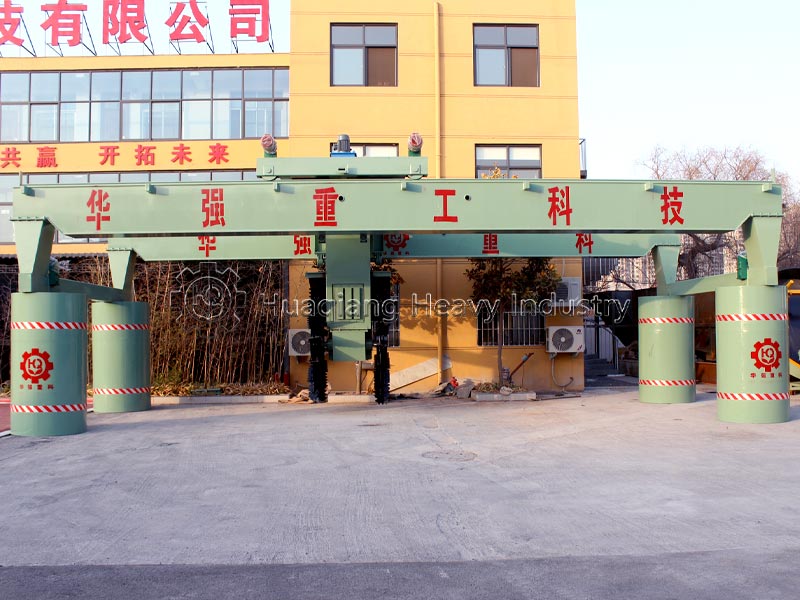
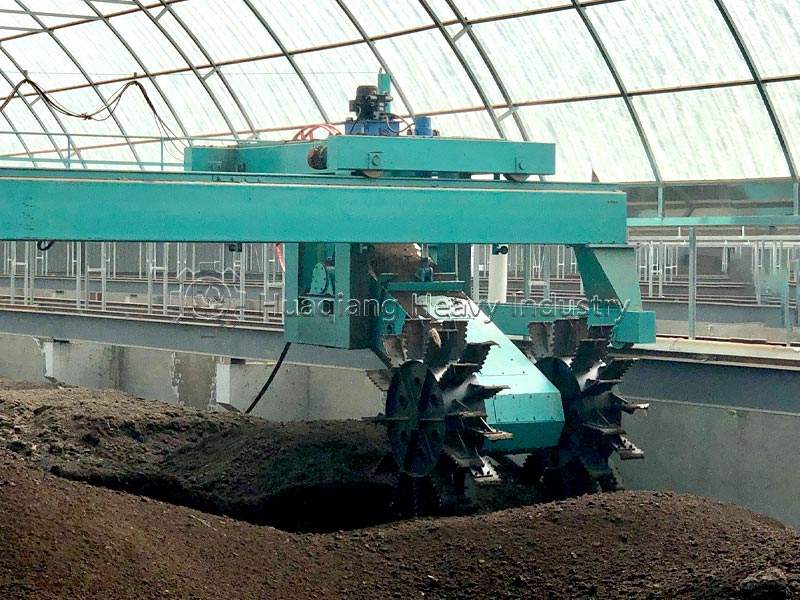
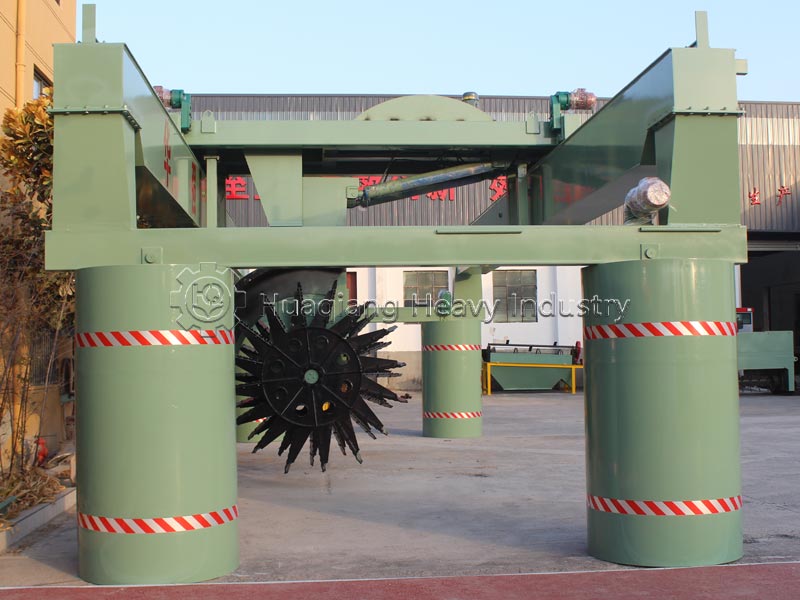
The large wheel compost turner is a fermentation turning machine that utilizes a large-diameter rotating wheel to cut into the material pile, scoop up the material, and cast it backward. Equipped with its own drive mechanism, it moves automatically along the windrow; as it travels and turns the material, the entire pile is shifted backward by a certain distance. It has minimal site requirements—operating effectively on any flat, paved surface—and allows for flexible adjustments to the windrow's orientation and length based on site conditions. The core component is a large wheel fitted with multiple sets of turning tines; the structure is simple, the drive train is short, and maintenance demands are low. For small-to-medium composting projects with limited budgets for civil engineering or irregularly shaped sites, the large wheel compost turner is a highly practical choice.
Working Principle of the Large Wheel Compost Turner
The operation of the large wheel compost turning machine can be summarized as "wheel rotation for scooping and machine travel for advancement." A large-diameter wheel is mounted at an angle at the front of the machine, with multiple sets of turning tines distributed along its circumference. A motor drives the wheel to rotate at high speed via a gearbox and chain drive; the tines cut into the base of the pile, scooping up material in the direction of the wheel's rotation. As the wheel turns, the material is lifted to a certain height before being cast backward tangentially by centrifugal force; it disperses in the air and lands behind the original pile. Simultaneously, a travel motor drives the machine slowly forward along the windrow, allowing the wheel to advance continuously and the tines to cut into fresh sections of the pile. After each pass, the entire windrow has been turned, the material has been redistributed (mixing inner and outer layers), and the pile as a whole has shifted backward.
What are the operational requirements for the large wheel compost turning machine?
Turning frequency. Freshly piled material often has high moisture content and tends to compact; ideally, it should be turned once daily during the first few days to facilitate moisture evaporation and oxygen replenishment, preventing anaerobic conditions and odors at the bottom. Once the high-temperature phase begins—when material decomposition is most active—the material should be turned at least once a day. This process moves cooler outer material into the high-temperature inner zone, ensuring that all material undergoes thorough high-temperature treatment. Once the temperature naturally drops, the material enters the maturation phase; turning it every two or three days is sufficient to allow it to stabilize gradually.
Wheel penetration depth. The turning tines should reach the bottom of the pile without touching the ground, maintaining a clearance of 3–5 cm between the tine tips and the ground surface. If the penetration is too shallow, the bottom layer won't be turned up, leading to blackening and foul odors over time; if it is too deep and hits the hard ground, the tines will wear out quickly or even break.
Travel speed must be matched with the wheel rotation speed. With the rotation speed constant, a slower travel speed results in finer turning and a more thorough process but lower throughput; a faster speed results in coarser turning and higher throughput but may leave some material unturned.
Safety precautions. When the equipment is running, the wheel spins rapidly with great force; never allow anyone to stand behind the machine within the discharge zone, as being struck by material thrown by the tines can cause injury. When the machine turns at the end of a pile, ensure the ground is level to prevent tipping.
How should the large wheel compost turning machine be maintained?
Daily checks before startup and after shutdown. Before starting, check for loose or detached tines, assess tine wear, and ensure the wheel rotates freely. After shutting down, clear away any fibrous material or wet clumps adhering to the wheel and tines; if left to harden, these residues can accelerate tine wear and disrupt the wheel's dynamic balance upon the next startup.
Weekly inspections and lubrication. Apply grease to the main wheel bearings and travel wheel bearings once a week; wipe dirt and dust from around the grease nipples before application. Check the tension of chain or belt drives weekly; tighten loose chains and apply machine oil to dry chains to prevent rust.
Monthly comprehensive maintenance. Remove the tines to carefully inspect wear; replace them if more than one-third of the tine tip has worn away, as shortened tines reduce turning efficiency and increase power consumption. Check the travel wheel treads for even wear and investigate the cause of any abnormal wear. Tighten all bolts on the machine, paying special attention to the tine mounting bolts and bearing housing bolts.
What is the investment cost for a large wheel compost turning machine?
Equipment purchase costs vary depending on specifications and configuration. Compared to trough-style turners, the large wheel compost turning machine has a simpler structure—lacking the large gantry frames and long main shafts that span the trough—resulting in lower manufacturing costs; for the same processing capacity, the price is usually more economical. Regarding configuration, remote-controlled models cost slightly more than manual ones, dual-wheel versions are pricier than single-wheel ones, and units with higher motor power cost more than those with lower power.
In terms of site preparation, the major advantage of the large wheel compost turning machine is that it does not require the construction of concrete fermentation troughs or the laying of tracks. A flat, hardened surface—such as a concrete slab or compacted crushed stone—is sufficient. The required site size depends on processing capacity; for instance, handling a dozen or so tons of material daily requires only a few hundred square meters of space. Civil engineering costs are primarily limited to surfacing the ground and erecting a rain shelter, representing significant savings compared to the infrastructure required for trough-style fermentation.
Operating costs mainly consist of electricity and the replacement of wear parts. With a total power rating of 20–30 kW and daily operation of one to two hours, monthly electricity costs are minimal. Wear parts primarily include the turning tines, which typically need replacing every few months to a year; chains or belts also require periodic replacement, but these costs are low. The equipment can be operated by a single person, keeping labor costs down as well.
| Model | Main Motor | Small Car Moving Motor | Big Car Moving Motor | Hydraulic Pump Motor |
| LP-10m | 55KW | 1.5KWX4 | 1.5KWX2(4) | 4KW |
| LP-12m | ||||
| LP-15m | ||||
| LP-20m |