
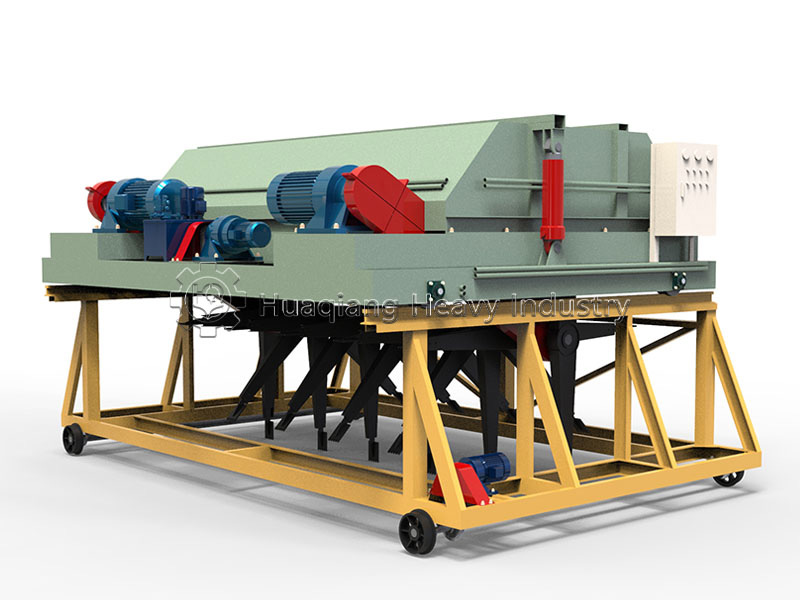
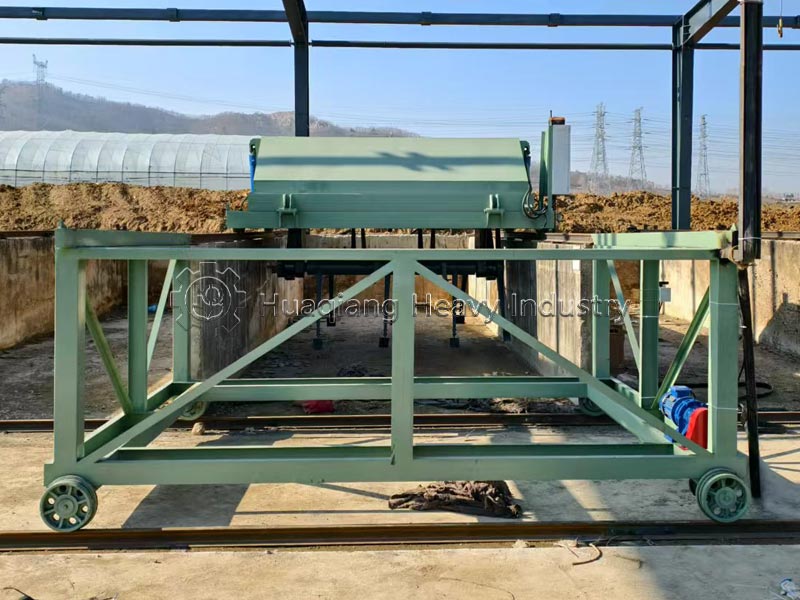
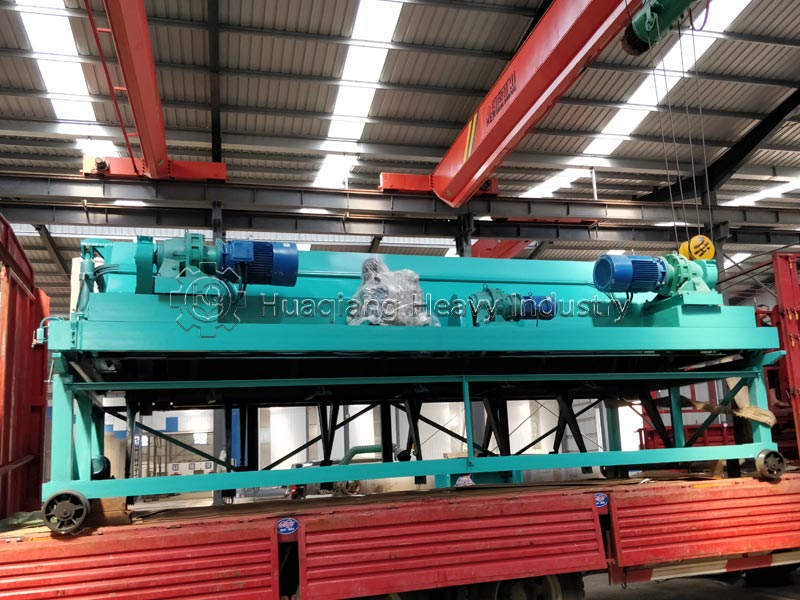
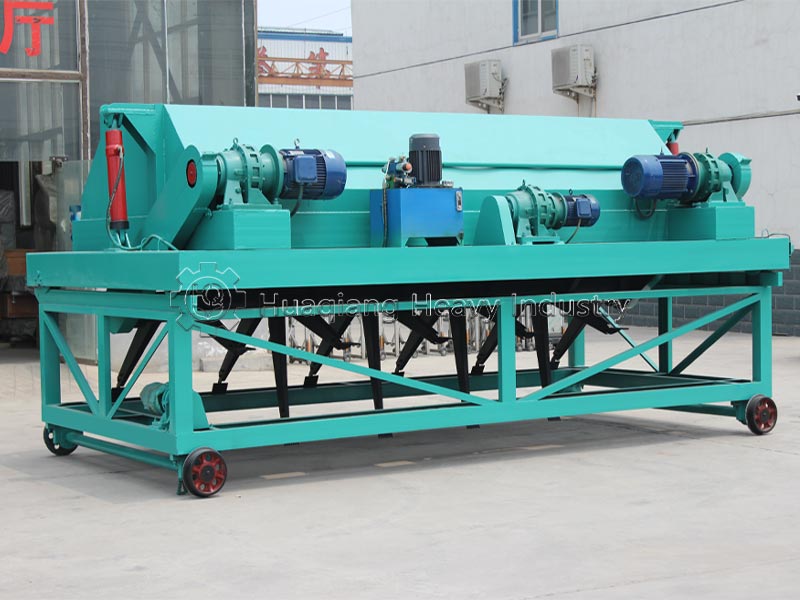
The hydraulic trough compost turning machine is industrial-grade equipment designed for large-scale aerobic fermentation of organic solid waste, featuring a fully hydraulic drive architecture that optimizes core system performance. Utilizing a gantry-style structure mounted on rails along both sides of the fermentation channel, the machine leverages the flexible transmission and load-adaptive capabilities of its hydraulic system to smoothly handle materials with varying physical properties. An integrated overflow protection mechanism automatically buffers the rigid shocks caused by hard objects jamming the mechanism. Operation is managed via a centralized control console allowing for precise, effortless parameter adjustment; the unit is particularly well-suited for organic fertilizer production, municipal sludge disposal, and large-scale livestock manure treatment projects requiring high daily throughput and continuous operation.
Working Principle
Powered by a central hydraulic pump station, the machine achieves precise coordination of travel, turning, and lifting actions through independent multi-circuit hydraulic controls. Upon startup, the hydraulic pump converts power into hydraulic energy, distributing it to various actuators via an integrated control valve assembly: the travel circuit drives hydraulic motors and reduction gears on both sides to propel the machine back and forth along the channel rails at a steady speed—with travel velocity smoothly and continuously adjustable by regulating oil flow—while the turning circuit drives a high-speed spindle motor to rotate the turning roller shaft spanning the channel. Wear-resistant teeth arranged in a spiral pattern on the roller cut into the material pile from the bottom, sequentially performing cutting, lifting, and throwing actions. The material is thoroughly broken up, oxygenated, and cooled in mid-air before falling back into the channel and gradually shifting along its length, thereby facilitating a progressive, sequential fermentation process for the entire batch.
What are the operational requirements for the hydraulic trough compost turning machine?
Pre-start checks: Before operation, verify that the hydraulic station's oil level is within the normal range and that there are no signs of leaks in the oil lines; ensure the fermentation channel rails are free of obstructions and the turning roller is free of material entanglement or foreign object jams; and confirm that all limit switches and emergency stop devices are fully functional and that control handles are returned to the neutral (zero) position.
Startup and Operation Protocols: Follow the sequence of "warm up the hydraulic station under no-load conditions first, then gradually apply load for operation." Conduct a no-load test run for 1–2 minutes to ensure there are no abnormal noises or issues with travel, lifting, or turning/aerating actions; then, slowly lower the turning roller shaft into the material. Forced startup under load is strictly prohibited.
Parameter Adjustment Requirements: Adjust turning depth and travel speed smoothly based on material characteristics; avoid abrupt movements of control handles that could cause hydraulic shock. For high-viscosity or high-pile materials, reduce travel speed appropriately to prevent frequent overload protection triggers caused by sustained excessive loads.
Abnormal Condition Handling: If an overload shutdown occurs during operation, first lift the turning roller shaft to clear the material pile, identify and remove any obstructing foreign objects, and then restart; repeated forced restarts are prohibited as they exacerbate component damage. Immediately shut down and disconnect power for inspection if oil leaks, abnormal noises, or vibrations occur.
Shutdown and Cleanup: After operation, raise the turning roller shaft to the highest position and park the equipment at the designated location at the end of the track. Shut down the hydraulic station and main power supply in sequence; clean off material adhering to the roller shaft, frame, and travel wheels, and ensure the equipment surface is cleaned and protected.
How should the hydraulic trough compost turning machine be maintained?
Routine Basic Maintenance: Clean material residue from the turning tines, frame, and travel wheels before and after each operation to prevent corrosion caused by long-term material adhesion. Check hydraulic oil levels and temperature; verify that hydraulic connections are leak-free and tracks are not deformed or loose; promptly retighten any loose fasteners on the turning tines.
Hydraulic System Specialized Maintenance: Check hydraulic oil cleanliness after 500 hours of cumulative operation; replace with the same grade of oil if impurities or emulsification are detected. Replace suction and return oil filter elements and clean the inner walls of the hydraulic tank after 1,000 hours of cumulative operation. Regularly inspect hydraulic cylinder seals; replace oil seals promptly if leakage occurs to prevent contaminants from entering the hydraulic circuit.
Maintenance of mechanical components subject to wear: Regularly inspect the wear level of the turning tines; promptly build up (via welding) or replace tines when the tip wear exceeds one-third of their length to ensure effective turning and aeration. Quarterly, check the fit and wear between the travel wheels and rails, adjust wheel assembly clearances, and replenish the reduction gear mechanism with high-temperature resistant grease.
Maintenance during prolonged inactivity: When the equipment is idle for an extended period, raise the turning roller shaft to its highest position and lock it in place; thoroughly remove residual material from the machine and apply anti-rust treatment. Apply anti-rust wrapping to hydraulic cylinder piston rods, consider replacing the hydraulic fluid with an anti-rust grade depending on the duration of inactivity, and store the machine in a dry, well-ventilated area.
What is the investment cost of a hydraulic trough compost turning machine?
The investment cost of a hydraulic trough compost turning machine is primarily determined by three factors: equipment specifications, configuration level, and functional capabilities; overall, it falls into the mid-to-high-end category of channel-type turning equipment. Regarding specifications, small models designed for 3-meter narrow channels have a lower entry cost; standard mainstream models for 4–5 meter channel widths see the widest market application; and large, heavy-duty models for channels 6 meters or wider entail higher costs that scale with increased processing capacity. Regarding configuration, basic manually controlled models are moderately priced, while models featuring automation modules—such as automatic reciprocating movement, scheduled operation, and remote monitoring—command a premium, allowing for flexible selection based on the project's smart-operation requirements.
Compared to simple trough compost turners driven directly by electric motors, hydraulic trough compost turning machines require a 30%–50% higher initial investment. However, thanks to low failure rates (due to overload protection) and reduced wear on consumable parts (due to hydraulic transmission), long-term costs for spare parts and losses from downtime are significantly lower; the initial price difference is typically recouped within 2–3 years through savings in operation and maintenance costs.
| Model | Main Motor | Walking Motor | Moving Motor | Hydraulic Pump Motor |
| FPY4 | 22kw | 1.5kw | 1.1kw | 4kw |
| FPY5 | 30kw | 1.5kw | 1.5kw | 4kw |
| FPY6 | 37kw | 2.2kw | 1.5kw | 4kw |