
The creation of a single granule of compound fertilizer begins with the proportion of raw materials. What materials are actually used on the NPK fertilizer production line? Let's find out.
1. The Three Major Elements: Nitrogen, Phosphorus, and Potassium
Nitrogen sources primarily come from molten urea, ammonium chloride, or ammonium sulfate. Molten urea is sprayed into the NPK fertilizer granulator machine to provide readily available nitrogen; ammonium chloride is used as a filler nitrogen source in powder form.
Phosphorus sources are mostly monoammonium phosphate or diammonium phosphate. These basic phosphate fertilizers are used as the main phosphorus input, sometimes supplemented with phosphoric acid spraying, ensuring the phosphorus content meets standards and enhancing the granulation binding effect.
Potassium mainly relies on potassium chloride, which is added precisely after crushing. For chlorine-sensitive crops, the NPK fertilizer production line switches to potassium sulfate as the raw material.
2. Functional Additives
Urea and potassium chloride are prone to absorbing moisture when mixed, requiring the addition of talc or clay as an anti-caking agent. Ammonia gas is introduced during production, both to neutralize acidity and to react with phosphoric acid to generate ammonium phosphate slurry, improving granule strength. Some production lines also add humic acid or amino acids to produce enhanced-efficiency products.
3. Micronutrients
To meet formulation requirements, micronutrients such as zinc, boron, and iron are precisely added in sulfate form through a micronutrient formulation system to ensure balanced nutrition.
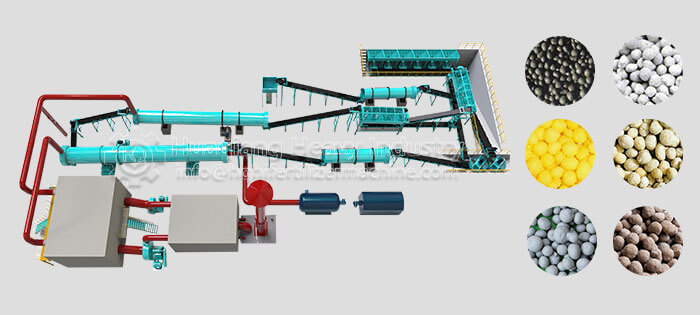
These raw materials are mixed, granulated, dried, and sieved to ultimately become uniformly sized compound fertilizer granules for use in farmland. Each granule carries a scientifically balanced ratio of nitrogen, phosphorus, potassium, and auxiliary materials, providing comprehensive nutrition for crops.