
Many factories pin their hopes for quality control on the inspection of finished products. However, inspection can only identify non-conforming items; it cannot alter the fact that a defect has already occurred.
Errors in the proportioning stage are cumulative. A discrepancy of a fraction of a kilogram during a single weighing may seem insignificant, but over the course of dozens of production batches, the deviation in nutrient content will gradually amplify. Even more insidious is the "zero drift" of weighing scales caused by humid or dusty environments; without regular calibration, these deviations snowball. When laboratory analysis reveals a nutrient deficiency in the finished product, the root cause often lies with the sensors, not the formulation itself.
Residual material left in the fertilizer mixer machine acts as a hidden source of cross-contamination between batches. On NPK production lines, formulations are frequently switched; if tens of kilograms of material from the previous run remain in the mixing drum, the nutrient ratios of the subsequent batch will be inadvertently diluted. While the amount of residue might be small enough that the product still passes laboratory testing, the consistency between batches is compromised. When customers complain that "this batch is different from the last," it is often a sign that accumulated residue has reached a critical threshold.
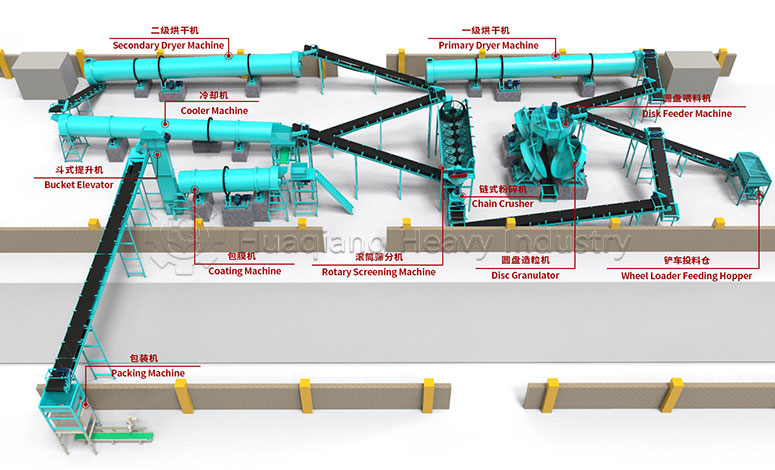
Segregation during the granulation process is the most difficult issue to detect. Urea, monoammonium phosphate (MAP), and potassium chloride differ in both particle size and specific gravity. During mixing, transport, and granulation, heavier particles tend to sink while lighter ones rise, leading to nutrient disparities among the granules within a single bag. While these differences might be "averaged out" during laboratory sampling, they manifest in the field as localized nutrient deficiencies or excesses.
The focus of quality management should shift from finished-product inspection to process control: regularly calibrating weighing scales, thoroughly clearing the system when switching formulations, and managing the particle size distribution of raw materials prior to granulation. These measures do not increase inspection costs, yet they mitigate deviations at the source. Ultimately, the quality of NPK fertilizer is not something that can be "inspected" in a laboratory; it is something that is built into the product through every step of the NPK compound fertilizer production line.