
Many fertilizer industry professionals confuse the raw materials used in the production of NPK compound fertilizer and NPK blended fertilizer, believing they are interchangeable. In fact, the raw material forms, pretreatment requirements, and auxiliary material ratios of the two production lines differ significantly.
The basic raw material forms differ significantly. NPK compound fertilizer production lines primarily use powdered raw materials, commonly employing fine materials such as urea powder, monoammonium phosphate powder, and potassium chloride powder. The uniform and fine powders allow for thorough mixing and reaction. NPK blending fertilizer production lines, on the other hand, directly use finished granular raw materials, relying on the direct ratio of granular urea and granular phosphate and potassium fertilizers, without altering the original form of the materials.
The raw material pretreatment standards also differ. Compound fertilizer production has strict requirements for raw materials; agglomerated materials must be crushed and sieved, and humidity must be precisely controlled, with pre-humidification and blending to ensure the materials are suitable for the granulation process. Blended fertilizer raw materials do not require crushing or humidification pretreatment; they only need to be intact and free of impurities before direct blending, simplifying the process.
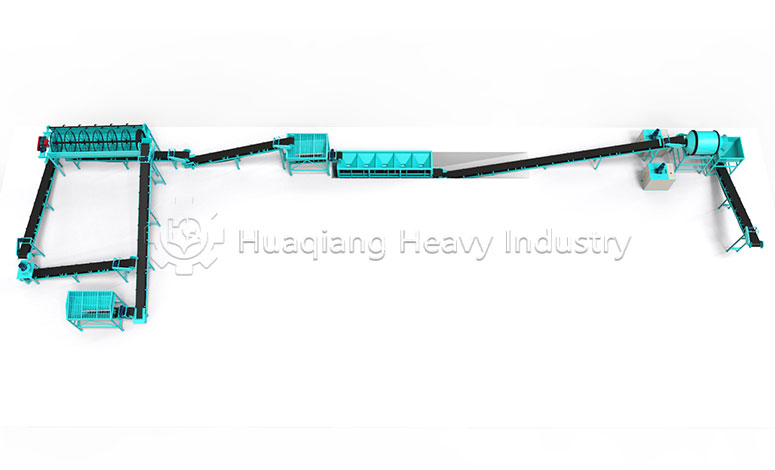
The use and proportioning logic of auxiliary materials also differ. Compound fertilizer production requires the addition of binders, conditioners, and other auxiliary materials to aid in material formation and enhance granule strength. The formulation must balance reaction efficiency and granulation quality. Blended fertilizers, on the other hand, involve only physical mixing and require no auxiliary materials; they only need to be formulated strictly according to nutrient standards to meet requirements.
In summary, compound fertilizers are suitable for refined powder processing, while blended fertilizers rely on simple formulations of finished granules. Processing plants can flexibly choose the appropriate fertilizer production line mode based on their own raw material conditions and production needs.