
Stable and high-quality production of NPK fertilizer is the primary goal of fertilizer manufacturers. Many factories suffer from unstable product quality and low efficiency in daily npk fertilizer production despite complete production lines. Most issues result from unreasonable parameter settings and non-standard operations throughout the npk fertilizer production process. Proper process optimization can eliminate common production flaws and boost overall factory profits effectively.
Three common problems widely exist in routine npk fertilizer production. First, uneven nutrient distribution caused by inadequate mixing. Raw materials differ in particle size and density, which easily causes material segregation before granulation or blending. Second, finished fertilizer caking during storage, mostly triggered by excessive residual moisture after drying. Third, low particle hardness and high powder content, which severely lower the commercial grade of final NPK fertilizer products.
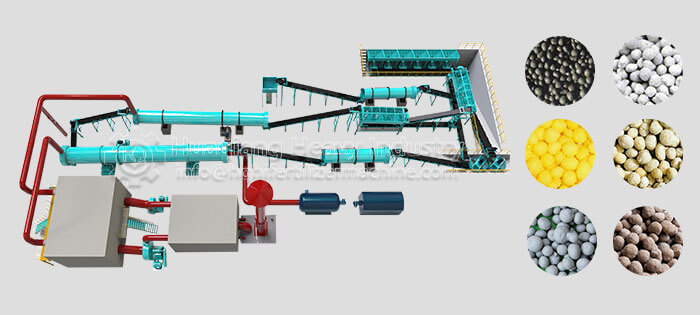
Targeted adjustments can greatly improve the entire npk fertilizer production process. To solve uneven nutrients, extend mixing time and match feeding speed with granulation speed to avoid material stratification. To prevent caking, control drying temperature and cooling time strictly to keep finished moisture within standard limits. To strengthen particle hardness, adjust water addition ratio during granulation and stabilize equipment operating speed for tighter particle formation.
Standard daily operation is also essential for smooth production of NPK fertilizer. Workers should conduct regular equipment inspections, clean residual materials after each production shift, and calibrate automatic batching systems regularly to avoid formula deviation. These routine maintenance steps can prevent most potential equipment faults and production errors in advance.
In summary, the production of NPK fertilizer requires not only standard process flows but also flexible on-site adjustments. Fine optimization of every link in the npk fertilizer production process cuts defective products and material waste, helping factories realize stable, cost-effective and high-quality npk fertilizer production in long-term operation.