
Compaction is a process that uses external force to expel voids in materials and increase density, and it is widely used in many fields. Based on the pressure principle and working method, the mainstream compaction types are divided into four categories, suitable for different materials and scenarios.
Static compaction is the basic type, relying on mechanical weight or hydraulic devices to apply continuous static pressure, causing material particles to rearrange and voids to shrink. The process is stable and impact-free, suitable for fine-grained materials, resulting in uniform compaction, but with limited effect on coarse-grained materials. In organic fertilizer production, double roller press granulators are typical static compaction equipment widely used in organic fertilizer production lines.
Impact compaction relies on instantaneous impact force to break through the material structure. High-intensity impact force is generated through the falling of heavy hammers or the rolling of impact wheels, achieving deep compaction. It is suitable for scenarios such as roadbed backfilling and landfill sites, improving deep-layer density, but the force needs to be controlled to avoid surface damage.
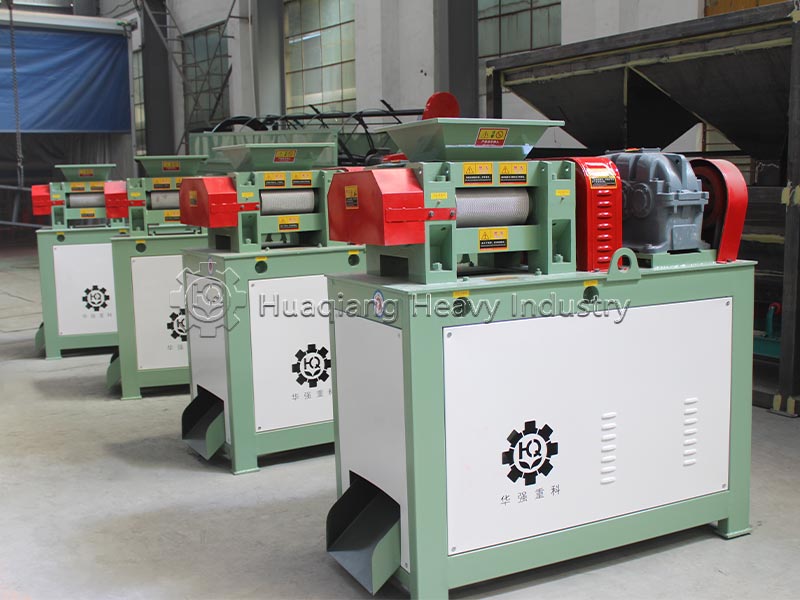
Vibratory compaction combines vibration and pressure. High-frequency vibration of the equipment suspends material particles, and pressure is applied to quickly fill the voids. Its efficiency far exceeds that of static compaction, and it is suitable for coarse-grained materials, offering both high efficiency and uniformity. As a commonly used organic fertilizer production equipment, it can be integrated into organic fertilizer production lines to compact coarse-grained raw materials or semi-finished products.
Composite compaction integrates multiple principles and can switch working modes, balancing surface uniformity and deep-layer density. It is suitable for complex materials and high-standard scenarios, and can adapt to raw materials with different moisture content and particle sizes, enabling precise pressure control and helping to improve the quality of organic fertilizer products.